
Massachusetts Commissioner of the Department of Public Health Dr. Robbie Goldstein joined GBH’s Morning Edition to talk about maternal health and a new report on the five-year impact of banning flavored tobacco products. The following transcript has been lightly edited for clarity.
Mark Herz: So we’ll start with maternal health. Your department has been making efforts in multiple areas to improve pre- and post-natal care. One example — the latest data shows more than one in 10 mothers in Massachusetts have had inadequate prenatal care. So tell us about what’s being done to improve those numbers and to support new mothers.
Robbie Goldstein: I think we’re doing a lot at the [Massachusetts] Department of Public Health, and mostly in collaboration with our state colleagues, especially those at MassHealth, the state Medicaid program. And a lot of this derives from the maternal health law that was signed by Gov. Healey almost a year and a half ago now. And that law gave us a lot work to do.
So first, we have to update our regulations, specifically so that birth centers could be explored and opened across the commonwealth. Birth centers are a great place for low-risk moms to go deliver. Right now, we only have one that’s operational in Massachusetts, and we hope to see more open over the coming years. The law also allowed us to increase our efforts to get into community with pregnant people before they deliver and after they deliver. So those are things like going into homes for a home visiting program after someone delivers and they come home with their newborn. It helps us support getting folks into the WIC offices where people can get food and support around the time of delivery. We’ve also done a lot around perinatal mental health, making sure that people are screened for postpartum depression, and they’re linked for care when they need to be linked in with a psychologist, a psychiatrist, or even their primary care provider or obstetrician.
Herz: What do you think about that stat I mentioned in the question — one in 10 mothers in Massachusetts have had inadequate prenatal care? I mean, how does that compare, or how concerning do you think that is?
Goldstein: Well, it’s obviously concerning. We want everyone in the commonwealth to have access to the care that they need. We’re doing a lot of work with community health centers and with clinics out in the community to make sure that they can provide the type of prenatal care that’s necessary. Some of that looks like additional support from the Department of Public Health. Some of that’s done, as I said, in collaboration with our partners at MassHealth and some of the other insurers, so that we can make sure that care is accessible and affordable for people.
Herz: [I want to] talk about this report on flavored tobacco products. It’s a new one out from your department, and this is looking at a restriction that we have in the state on these kind of products. So tell us what you found.
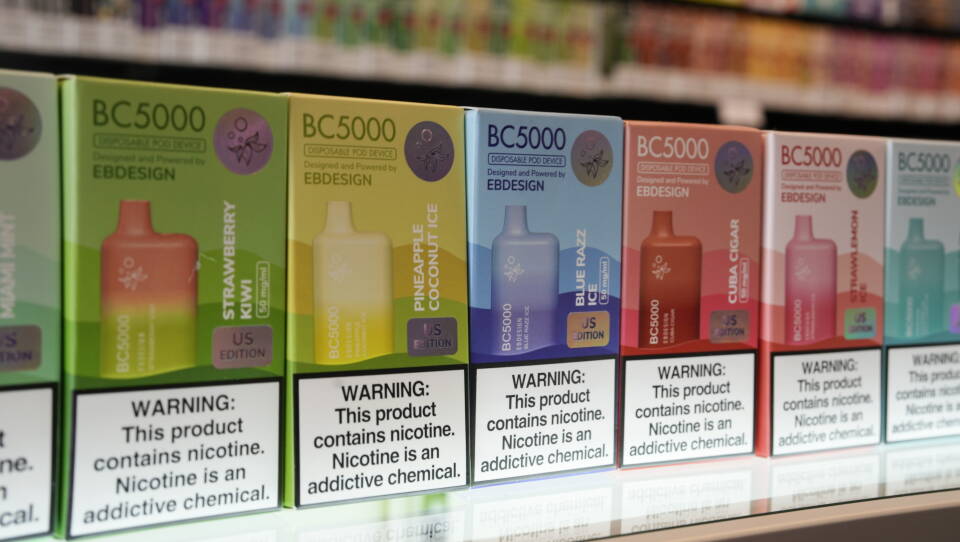
Goldstein: Well, it’s been five years since the state passed a really monumental law, a law that banned flavored tobacco products here in Massachusetts. And we took a look back over this five years to see what was the impact. Now, certainly there was an impact in the number of people who are using these products, because they’re outlawed. But what we were interested in is: What happened to the health of people here in Massachusetts? And it turns out, this law resulted in $70 million of healthcare savings, just by outlawing flavored tobacco here in Massachusetts. It’s pretty incredible.
Herz: And flavored tobacco is aimed mostly at a certain group of people, right?
Goldstein: Mostly at youth, right. We’re talking about flavored cigarettes, menthol cigarettes that were marketed in many ways directly to youth all across the country.
Herz: Well, tell me more about how you did this study.
Goldstein: So we partnered with a health economist, and the health economist helped us think through — what would the costs have been if flavored cigarettes continued to be here? So those are the costs of going in to see a physician or a healthcare provider, or the cost of potential cancer that might happen as someone continues to smoke. And then we look at what was the actual cost over the past five years. [That showed] savings — that $70 million savings just in the past five years from implementing this law.
Herz: And I’m expecting, we did say these are aimed at youth, that this could be the thin end of the wedge starting with these flavored products, right?
Goldstein: Yeah, so these products specifically are targeted to youth. And we know when youth begin to smoke at a young age, they’re much more likely to continue to smoke, and the health impacts of that smoking compound year over year over year. And so what we saw over these past five years really is just the tip of the iceberg, right? Because we’ve been able to outlaw these products here in Massachusetts, we’ve kept them off the shelves for five years. We expect to see more and more and more savings over time.
Herz: Also, I wanted to check in with you [about something]. Vinay Prasad, a powerful and some say actually de facto head of the FDA — is leaving his post. And he was the official who initially had killed a review of Moderna’s flu vaccine, and that was something we had talked about last month, so I wanted you to get your perspective on him leaving.
Goldstein: Yeah, well, I think it’s no surprise to listeners here, people across Massachusetts, that I’ve taken some concern with where the FDA has moved under the Trump administration. And in particular, Dr. Prasad has been someone who has pushed out a lot of mis- and disinformation, specifically about vaccines. So I have to say, it is actually comforting to me that he is leaving FDA, and I’m hopeful that whoever comes in behind him, will have a more evidence-based approach to vaccine policy.
Herz: And when you say you’re hopeful, I think about how ultimately, these people all answer to Robert F. Kennedy Jr. — a known vaccine skeptic, as we always point out. So what makes you hopeful?
Goldstein: Well, I think we are seeing some shifts at the federal Health and Human Services over the past couple of months. For instance, Dr. Jay Bhattacharya, who is the NIH director, is now serving as the acting CDC director. And he came out in a public statement just last week saying that he supports the use of the measles vaccine, and he knows that the measles vaccine is both safe and effective. That’s a huge shift from what we’ve heard out of federal HHS in the past. And I hope we see more people standing up and speaking about the truth and what the data actually show.
Herz: Speaking of measles, we also talked last time about how there was measles in Maine. Is it coming our way? What’s the latest on measles?
Goldstein: Well, since I was here last month, we reported two measles cases here in Massachusetts. One of them was actually in an individual who was diagnosed out of state and didn’t return back to Massachusetts until after the infectious period. The other was in a returning traveler, someone who came back to Massachusetts and was diagnosed here in the state.
We’ve done all we need to do to reach out to people to let them know if they had a potential exposure. And I think the important message that we got out there was vaccination is the best way to protect yourself — and fortunately, here in Massachusetts, our vaccine rates are pretty high.