-

Tiya Miles: Eco-Consciousness in the Lives of Enslaved Black Women
Tiya Miles' scholarship examines enslavement in the U.S. South. In this lecture, she discusses the stories of several enslaved, Black women who drew upon their experiences and relationships with the natural world to find hope and help them achieve the lives they imagined.
Miles has consulted with colleagues at historic sites and museums on representations of slavery, African American material culture, and the Black-Indigenous intertwined past, including, most recently, the “Fabric of a Nation” quilt exhibition at the Museum of Fine Arts in Boston.
She is a MacArthur Genius and an award-winning author who has published eleven books, essays and reviews in The New York Times, The Boston Globe, The Atlantic, The New York Review of Books, as well as other publications. Her time-bridge novel The Cherokee Rose, is a ghost story set in the plantation South.
***
This lecture is co-sponsored by Boston College History Department, American Studies, African and African Diaspora Studies, Women’s Studies, Environmental Studies, the Boisi Center for Religion and American Public Life, and the Forum for Racial Justice in America.
The Lowell Humanities Series is sponsored by the Lowell Institute, Boston College's Institute for the Liberal Arts, and the Provost's Office.Partner:Boston College -
American Foreign Policy at a Crossroads
What are the decisions, risks, and opportunities that lie ahead in an increasingly tumultuous international landscape? Michael Poznansky, Associate Professor and author on International Relations, responds.Partner:WorldBoston -
Michael Poznansky
Michael Poznansky is a professor of international relations and author of "Great Power, Great Responsibility: How the Liberal International Order Shapes US Foreign Policy" (Oxford University Press, 2025) and "In the Shadow of International Law: Secrecy and Regime Change in the Postwar World" (Oxford University Press, 2020). -
The Deep Dive: Strutting into the World of Fashion
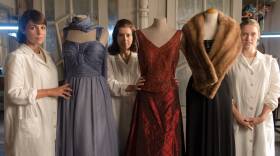
Dive deep into the world of fashion. Learn about the history of blue jeans, fashion in our drama series, the life of the late Giorgio Armani, and a local designer on Project Runway. -
A.I. AND THE DEATH OF CRITICAL THINKING
Schools and colleges are open for business – it’s the fall semester – but the statistics are depressing. Nationally, high school seniors have scored the worst on reading results since 1992. The data, from the respected National Assessment of Education Progress, showed that a third of 12th-graders who were tested last year, did not meet basic reading skills. Forbes magazine recently reported on the “dark side of AI: tracking the decline of human cognitive skills” and the National Endowment for the Arts noted that federal data showed a slump in reading for pleasure. So, is any or all of this attributable to the invasion of AI into our kids’ classrooms?
ChatGPT was initially pitched as a useful technological “tool”, yet more educational analysts are expressing concerns that tests show we are losing fundamental critical thinking skills in the process. As Sarah O’Connor commented in a Financial Times opinion piece, “without solid skills of your own, it is only a few short steps from being supported by the machine, to finding yourself dependent on it, or subject to it.”
MIT’s recent media study published unsettling results on cognitive performance using ChatGPT and the only people who seem unconcerned are Sam Altman and other tech leaders. CF has put together a panel of AI observers, including a neuroscientist, a professor of humanities and a student to discuss some of the challenges and concerns associated with generative AI and learning. Until we know more about the cognitive effects of technology like ChatGPT, should we be inserting it into the classroom? And if, as recent studies indicate, it homogenizes thinking and creativity, are we content to let our kids’ education go into experimental free fall?Partner:Cambridge Forum -
Ashanty Rosario
Ashanty Rosario is a Senior at Newtown High School in Queens, New York City. She developed an interest in journalism as a way to expand her writing beyond the comforts of fiction and to strengthen her communication skills through interviewing. She aspires to amplify the voices of underrepresented communities in media and uphold journalism’s pledge to truth and public service. Ashanty has published work in collegiate summer newspapers, such as New York University’s The Spectrum and Princeton University’s Princeton Summer Journal, and recently wrote for the Atlantic. In the future, she plans to pursue a Bachelor’s Degree in Creative Writing or English Literature, aiming to become a published author while also freelancing in journalism. -
Celia Ford
Celia Ford is a journalist and neuroscientist based in the Bay Area, covering AI policy at Transformer. Previously, Celia completed reporting fellowships at Vox's Future Perfect, WIRED, and The Open Notebook, where she wrote about emerging technology, the mind, public health, and (once) pole dancing. Celia has a bachelor’s degree in cognitive neuroscience from Brown University and a PhD in neuroscience from UC Berkeley. -
Kathleen DuVal on “Native Nations: A Millennium in North America”
The American Ancestors American Inspiration series and Boston Public Library present the 2025 Pulitzer Prize–winning author Kathleen DuVal to discuss her book, "Native Nations."Partner:American Ancestors -
Nicole Eustace
Nicole Eustace is Julius Silver Family Professor of History at New York University, where she directs the NYU Atlantic History Workshop. Her most recent book, “Covered with Night: A Story of Murder and Indigenous Justice in Early America,” won the Pulitzer Prize in History and the Francis Parkman Prize from the Society of American Historians. It was a finalist for the National Book Award and was named Best Book the Year by TIME, Smithsonian, Boston Globe, and Kirkus Reviews. She is also the author of “1812: War and the Passions of Patriotism and Passion Is the Gale: Emotion, Power, and the Coming of the American Revolution.” She is currently a Guggenheim fellow. -
Kathleen DuVal
Kathleen DuVal is a Pulitzer Prize–winning historian. She is professor of history at the University of North Carolina at Chapel Hill, where she teaches early American and American Indian history. Her previous work includes Independence Lost, which was a finalist for the George Washington Prize, and “The Native Ground: Indians and Colonists in the Heart of the Continent.” She is a coauthor of “Give Me Liberty!” and coeditor of “Interpreting a Continent: Voices from Colonial America.”