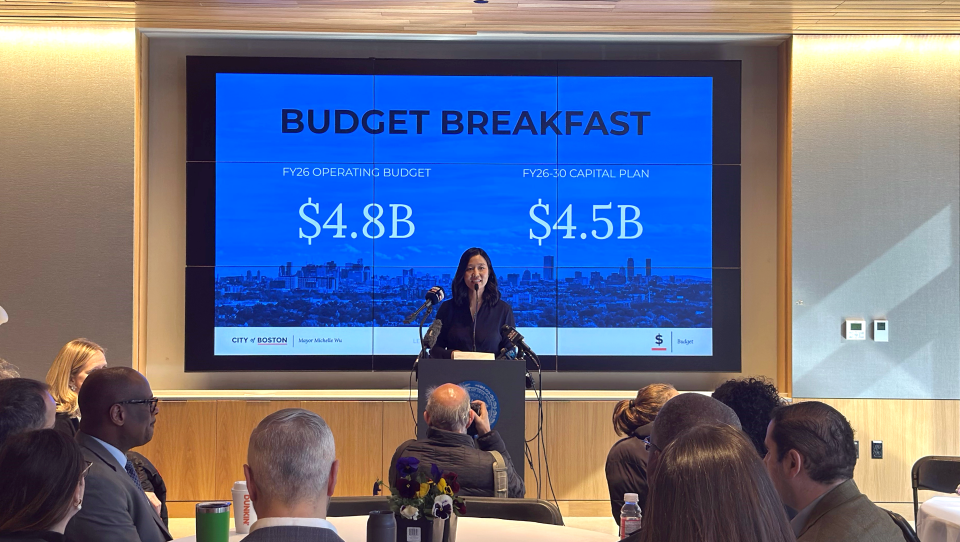

Boston Mayor Michelle Wu gave a preview Monday of the $4.9 billion fiscal year 2027 budget she intends to formally propose to the City Council later this week. She says the budget focuses on protecting city services while making “difficult, targeted” cuts.
Wu’s proposal comes as the city faces a nearly $50 million deficit brought on snow removal, healthcare and public safety costs. In a letter to the City Council, Wu said while the moment is hard, Boston is navigating the conditions with a “deliberate and disciplined” approach.
“Ask any mayor, and you’ll hear that it is a difficult moment here in Boston, across the commonwealth, and around the country,” Wu said on a call ahead of the release of her transmittal letter to the council. “The economic uncertainty that we are all experiencing, along with rising fixed costs, slowing revenue growth, and inflationary pressures are really creating a perfect storm for local governments everywhere.”
“This is a difficult moment—but Boston meets it from a position of durability and determination. More than a decade of triple-A bond ratings, disciplined financial stewardship, and strong reserves have positioned the City to weather this environment,” the mayor’s letter said.
While we won’t have full details on Wu’s recommended spending plan for Boston until Wednesday’s traditional budget breakfast — an event the mayor said will be downsized given financial headwinds — here are three things we already know.
1. Wu’s recommended $4.9 billion budget increases spending by 2% when compared to last year’s budget.
The mayor said it represents “the lowest rate of increase,” since 2009, when the U.S. economy was reeling from the Great Recession.
“This limited growth has required tough choice, including targeted reductions,” she said in her transmittal letter to the council Monday.
One area the mayor said will see an unspecified increase is the city’s Streets Cabinet, for contractual costs “managing the City’s mobility infrastructure, collecting residential trash, and maintaining the cleanliness of our public ways,” her letter said.
2. Wu’s upcoming budget proposal does not seek a tax override from the state, nor does it tap into city reserves.
Wu said in her letter that “unlike many other Massachusetts communities, this budget does not seek an override for additional revenue beyond what is allowed by Proposition 2 ½,” the 1980s voter-approved state law that limits the amount of revenue a city or town may raise from local property taxes each year to fund municipal operations.
She described the choices as ensuring Boston is delivering services within its means. Officials familiar with the city’s budget process said declining to tap into its $1.2 billion reserves ensures there won’t be structural issues spawned from using a one-time source to balance costs.
It also does not layoff any city employees, the mayor said.
3. Wu’s proposed budget will cut discretionary spending programs.
Wu described the balancing cuts as mostly coming from “discretionary grant programs” previously supported by federal pandemic relief funds.
“Many of the grant programs that I think will be very deeply felt are ones that provided resources to our nonprofit partners,” the mayor said during the preview briefing, adding that public-private partnerships can help address the gaps.
Two places the mayor said were poised to see cuts were Age Strong, the city services department dedicated to senior residents, and the Mayor’s Office of Housing.



