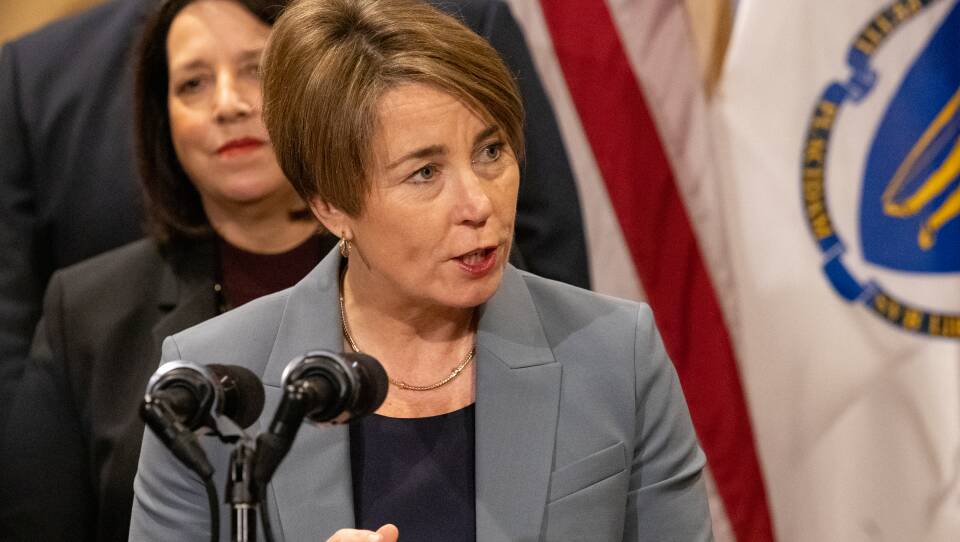


Gov. Maura Healey emphasized to business leaders on Monday the need to bring more energy sources to Massachusetts to drive down costs and increase the state’s business competitiveness.
Healey has repeatedly vowed to lower costs for Massachusetts residents since taking office in 2023. She echoed that call in remarks to the New England Council at the Seaport Hotel in Boston.
“That’s why I’ve opposed big rate hikes,” Healey said. “I found some extra money out there so that I could give folks 25% off of their electric bills and 10% off of gas bills. But we need to do so much more.”
The governor’s comments come three weeks after she signed an executive order calling on state agencies to add 10 gigawatts of power to the state’s supply to help decrease residents’ increasingly costly energy bills.
Healey said that’s enough power for two million homes.
“We’re going to need it because we’ve got to save people and businesses money,” she said. “By the way, it will save them $10 billion.”
The executive order also calls for an additional five gigawatts of energy storage by 2035 and is focused on bringing in various types of energy, including solar, wind, gas, nuclear, geothermal and hydro.
“With energy abundance and energy independence, we can protect Massachusetts from global market shocks,” Healey said.
Healey also emphasized the need for more “homegrown energy sources” as the war in Iran continues to drive up gas and home heating oil prices for residents.
That includes the prices of diesel and jet fuel, which is raising the cost to transport goods by truck, train or plane.
Massachusetts is now receiving hydropower from Canada, but the Trump administration has slowed down its efforts to develop commercial scale offshore wind power.
The state’s first and only offshore wind project Vineyard Wind also finished construction earlier this month.
Healey said Vineyard Wind is now powering 400,000 homes and businesses off the south coast of Massachusetts.
“Last week we issued a joint commitment with all New England governors and New York to explore advanced nuclear energy,” she said. “We’ll keep working with the Legislature on a bill that would get us more energy at lower prices.”
The Massachusetts House passed an energy affordability bill in February, which top House Democrats say would save ratepayers $9 billion over 10 years. That legislation makes a $1 billion funding cut to the state’s energy efficiency program, Mass Save, with a goal of delivering nearer-term savings on energy bills, though environmental advocates have called the cut counterproductive.
Senate President Karen Spilka said last week she hopes to have a Senate rewrite of the bill ready for debate “soon,” but didn’t offer a set timeline.
Energy affordability has also been a prominent issue on the campaign trail. While Healey touts her focus on cutting costs and boosting supply, the three Republicans vying to challenge her in November — Mike Kennealy, Mike Minogue and Brian Shortsleeve — say Healey administration green energy policies are to blame for higher utility bills.
Healey’s efforts appear to have support from some business leaders, who note that rising costs could affect the state’s competitiveness.
Associated Industries of Massachusetts President and CEO Brooke Thomson previously spoke in support of Healey’s order.
“These high costs act as a hidden tax on economic growth and prosperity,” she told the New Bedford Light. “When competition is at an all-time high, Massachusetts literally cannot afford high energy costs making our industries less competitive.”
Healey echoed the challenge of keeping talent in Massachusetts while emphasizing that creating more homegrown energy sources can lead to more jobs.
“We know what works,” she said. “We know what we need to do to lower costs, to build more homes more quickly, to get energy costs down, and to provide a more stable and competitive business environment.”