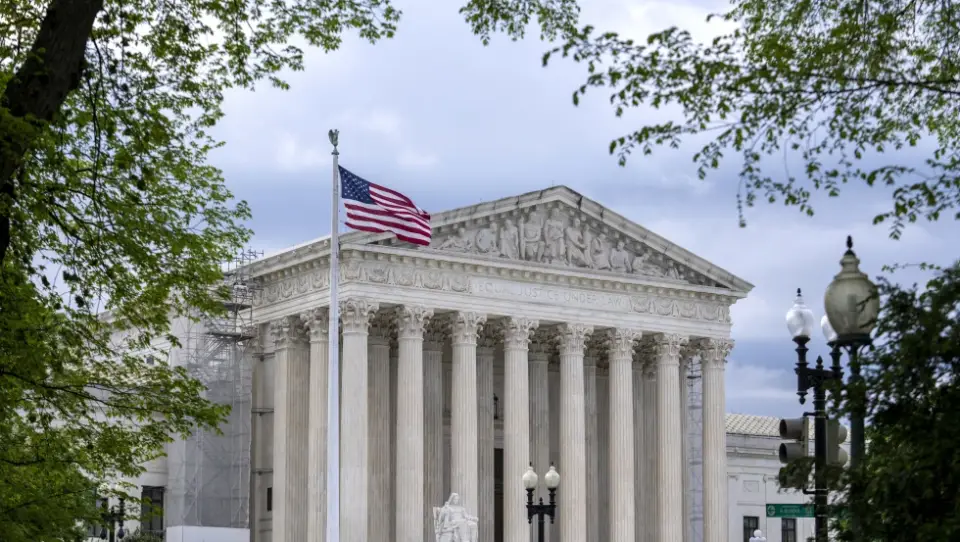
The Supreme Court on Tuesday upheld a broad conception of birthright citizenship, rejecting President Donald Trump’s executive order declaring that children born to people who are in the United States illegally or temporarily are not American citizens.
The justices relied on a long-settled understanding of the 14th Amendment, adopted after the Civil War, and more recent federal laws in ruling that anyone born in the country, with very limited exceptions, is a citizen. Locally, advocates are celebrating the 6-3 ruling.
“The court has rebuked and vacated the executive order trying to strip the children of immigrants of citizenship,” said Iván Espinoza-Madrigal, executive director of the Boston-based legal advocacy organization Lawyers for Civil Rights. “This decision is monumental. It means that all children born in the United States may continue to live, learn, grow, and become part of our society in ways that the Constitution has envisioned and in ways that many generations have become accustomed to.”
The majority opinion was written by Chief Justice John Roberts.
“He says that citizenship then and now was the right to have rights to freely participate in our political community,” said Carol Rose, executive director of the ACLU of Massachusetts. “The framers of the 14th Amendment extended that promise to every freeborn person in this land, and we keep that promise today.”
Trump’s order would have upended widely held views that the 14th Amendment confers citizenship on everyone born in the U.S., excluding only the children of foreign diplomats and those born to a foreign occupying force.
The amendment was intended to ensure that Black people, including former slaves, had citizenship, though the Citizenship Clause is written more broadly. “All persons born or naturalized in the United States, and subject to the jurisdiction thereof, are citizens of the United States and of the State wherein they reside,” it reads.
Rose believes the court had to rule this way for any “semblance” of democracy to be upheld.
“They argued that the fundamental right of birthright citizenship — meaning that if you’re born in this country, you have a right to be a citizen automatically — is so fundamental,” Rose said. “I mean, can you imagine if they’d ruled the other way? It would have created a permanent class of stateless people in this country, sort of an apartheid system.”
Sarang Sekhavat, chief of staff at the Massachusetts Immigrant & Refugee Advocacy Coalition, was born in Brockton to immigrant parents from Iran on temporary visas. He described the decision as a “relief” for many.
“If the president’s executive order had been in place then, I would not have been a U.S. citizen,” he said. “A negative decision on this case would have basically told me, ‘Yeah, my citizenship was a mistake and I never should have been considered an American citizen.’”
Sekhavat said that’s what the 14th Amendment is about at its core: “It’s making sure that people who are born here do belong here. You can’t really have a democracy without that.”
The Republican president’s restrictions had been blocked by several lower courts and had not taken effect anywhere in the U.S. The birthright citizenship order, which Trump signed on the first day of his second term, is part of his administration’s broad immigration crackdown.
Lawyers for Civil Rights also sued the Trump administration over the order, though it wasn’t their case that the Supreme Court was weighing. The organization secured a preliminary injunction against that order the first day, seeking to protect their clients from the constitutional questions addressed by the Supreme Court in Tuesday’s order. In that case, the plaintiffs were expectant mothers and members of La Colaborativa and the Brazilian Worker Center.
“Today, our children know what we have always known: they belong,” Gladys Vega, executive director of La Colaborativa, said in a statement on Tuesday. “This decision protects generations of families and the promise that every child born in this country deserves the same rights and the same future.”
More than one-quarter of a million babies born in the U.S. each year would have been affected by the executive order, according to research by the Migration Policy Institute and Pennsylvania State University’s Population Research Institute.
“Today is a victory for our children and for every family that had the courage to stand up for them,” said Lenita Reason, executive director of the Brazilian Worker Center. “No child should grow up wondering whether they belong in the country where they were born. Today’s decision ensures they won’t have to.”
During arguments in April, both conservative and liberal justices questioned the order’s legality in a momentous case that was magnified by Trump’s unprecedented attendance in the courtroom.
The case framed another test of Trump’s assertions of executive power that defy long-standing precedent for a court with a conservative majority and a robust view of presidential power that has largely ruled in his favor. In the notable exceptions when the court has not, Trump has responded with starkly personal criticisms of the justices.
Birthright citizenship was the first Trump immigration-related policy to reach the court for a final ruling.
Trump seemed to recognize the court was likely to rule against him on birthright citizenship, too, using his Truth Social platform to criticize “dumb judges and justices” and wealthy pregnant women from China and elsewhere who come to the U.S. to give birth so their newborns will have American citizenship.
In a series of decisions, lower courts have struck down Trump’s executive order as illegal. The decisions have invoked the high court’s 1898 ruling in Wong Kim Ark, which held that the U.S.-born child of Chinese nationals was a citizen.
The Trump administration argued that the common view of citizenship is wrong, asserting that children of noncitizens are not “subject to the jurisdiction” of the United States and therefore are not entitled to citizenship.
It is unclear how many people in Massachusetts are birthright citizens.
Local elected officials celebrated the decision.
“Birthright citizenship is central to who we are as a nation. It has provided certainty for families across the country and protects the rights of children born on American soil,” said Gov. Maura Healey. “The Supreme Court made clear today: President Trump can’t rewrite the Constitution.”
Attorney General Andrea Joy Campbell lauded the decision, but warned the public to remain wary of further efforts to limit or change the Constitution.
“That should remind all of us that our rights and freedoms are not self-executing. Some continue to test the limits of our Constitution in an effort to narrow who belongs in this country, who gets to fully participate in our democracy, and who gets to make those decisions,” she said.
While Trump has largely focused on illegal immigration in his rhetoric and actions, the birthright citizenship restrictions also would have applied to people who are legally in the United States, including students and applicants for green cards, or permanent resident status.
If the ruling had gone in the government’s favor, there would have been significant confusion and issues with birth certificate registration.
“Parents rely on hospitals to make sure that children can receive a birth certificate and get the birth certificate registered,” said Espinoza Madrigal. “Those functions would have not been possible had the executive order continued. Children rely on their birth certificate as evidence of U.S. citizenship because there is no other documentation to confirm their status other than a passport.”



