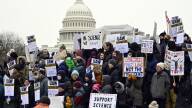
Boston federal judge stalls 4-year student visa cap
Judge says Trump administration’s proposed restriction could undermine research and the economy.


Podcast: College Uncovered
-

Who should hold power over higher education?
In July, the Trump administration’s sweeping overhaul of federal higher education policy and financing took effect. The changes touch nearly every part of the sector, from who can afford graduate school to who decides which scientific discoveries receive billions of dollars in taxpayer funding. Supporters say Washington is finally holding colleges accountable for their rising costs and pushing ideological agendas. Critics argue the federal government is taking control of decisions that have long been left to students, financial aid institutions, university leaders, and independent scientific experts.In this episode of College Uncovered, GBH’s Kirk Carapezza examines the growing power struggle over the future of American higher education – and what it means for students, researchers, and colleges.Plus, The Hechinger Report’s Jon Marcus breaks down the administration’s higher education agenda, from changes to graduate student lending to immigration and visa policies that are driving down international student enrollment. He explains what those shifts could mean not only for colleges dependent on international students’ tuition dollars but also for American students who are seeing fewer programs offered.----------Credits:Host and Producer: Kirk Carapezza Editors: Adeline Sire and Matt BaskinExecutive Producer: Azita Ghahramani Mixing and Sound Design: David Goodman & Gary MottTheme Song and original music: Left-RomanArtwork: Matt Welch Project Manager: Isabel HibbardConsulting Producer and Head of GBH Podcasts: Devin Maverick Robins"College Uncovered" is a production of GBH News -
The colonial campus where it happened? Not exactly.
The story of America’s founding comes with a familiar cast and setting: young white men in powdered wigs, animated by Enlightenment ideals, pacing college greens and tavern floors, debating liberty into existence. Colonial colleges emerge as engines of revolution – hotbeds of radical thought that helped give birth to the nation. It’s a compelling story. It’s also incomplete. In this special America 250 edition of College Uncovered, GBH’s Kirk Carapezza pulls back the ivy to reveal how America’s colonial colleges actually worked – and the complicated role they played in the nation’s founding.Suffolk University historian Robert Allison takes us to the Old Burying Ground just beyond Harvard Yard and describes a far less romantic version of campus life during the Revolution. In 1775, Harvard did not erupt in rebellion, Allison notes, it emptied out.David Hoeveler, historian and author of Creating the American Mind: Intellect and Politics in the Colonial Colleges, explains that students were wrestling with big questions about liberty, resistance, and self-government – just not in the classroom.University of Pennsylvania historian Kathleen Brown argues that colonial colleges weren’t just silent on slavery; many were built upon it. And independence did little to sever their ties to the British slave trade. Finally, Laurie Patton, president of the American Academy of Arts & Sciences, reflects on why a group of colonial college graduates led by John Adams founded the organization in Cambridge in 1780, its enduring mission, and what its history can teach us in this deeply fraught political and social moment.----------Credits:Host and Producer: Kirk Carapezza Editors: Azita Ghahramani and Lisa WardleExecutive Producer: Lee Hill Mixing and Sound Design: David Goodman & Gary MottTheme Song and original music: Left-RomanArtwork: Matt Welch Project Manager: Isabel HibbardConsulting Producer and Head of GBH Podcasts: Devin Maverick Robins"College Uncovered" is a production of GBH News -
Making A’s count
Harvard faculty have approved a controversial plan to overhaul the college’s grading system, including new limits on how many A’s professors can award. The goal: make an A mean something again.But the debate goes beyond transcripts and GPAs. At a moment of deep skepticism toward elite higher education, some supporters say tougher grading could also help restore trust in institutions like Harvard.In this episode of College Uncovered, GBH’s Kirk Carapezza heads to Harvard Yard, where high-achieving students worried about their futures are pushing back. And we hear from professors divided over a broader question: What are grades actually used for?Grade inflation has been rising for decades at colleges across the country. Economist Jeff Denning of the University of Texas at Austin explains why easier grading may weaken students’ incentives to study and to truly learn the material.Meanwhile, a faculty report from Yale’s Committee on Trust in Higher Education argues that grades at elite universities often no longer do what they’re supposed to do: measure and communicate learning. We hear from two of the report’s authors, sociologist Julia Adams and law professor Sarath Sanga.And finally, The Hechinger Report’s Jill Barshay explains why, in the age of the easy A, parents may be getting a misleading picture of how their kids are actually doing.Related links: Harvard limits number of students who get A gradesWith rampant grade inflation, could Harvard make an ‘A’ mean something again?Easy A’s, lower pay: Grade inflation’s hidden damageCollege Uncovered: What do college students learn, anyway?Parents trust report cards more than test scores — with consequences for kids----------Credits:Host and Producer: Kirk Carapezza Editors: Azita Ghahramani and Lisa WardleExecutive Producer: Lee Hill Mixing and Sound Design: David Goodman & Gary MottTheme Song and original music: Left-RomanArtwork: Matt Welch Project Manager: Isabel HibbardConsulting Producer and Head of GBH Podcasts: Devin Maverick Robins"College Uncovered" is a production of GBH News -
[BONUS] Measuring the Underemployed
Artificial intelligence is booming in Boston and beyond, and economists warn that it could throw thousands of people out of work.College seniors nearing graduation are often asked what they’ll do next. How will they put their new degree to use? Or will they end up working at their neighborhood coffee shop? Underemployment among recent graduates has been a persistent concern. Many degree holders find themselves in roles that don’t fully tap into their education. But tracking exactly how many graduates are underemployed, well, it’s complicated.Jeff Strohl, who directs Georgetown’s Center on Education and the Workforce, says the data is murky. Colleges don’t consistently track where graduates land, or how long it takes them to get there. That uncertainty feeds the familiar stereotype of baristas with diplomas living in their parents’ basements.“We dump all these graduates into the labor market — often three million at the same time — and then we’re telling them to go swim, and it takes a while to find a good match,” he said. Even without precise numbers, many in higher education agree that the rate of underemployment is too high, especially given that only about 60 percent of students in the U.S. complete a four-year degree on time.In this episode of College Uncovered, GBH’s Kirk Carapezza visits a job fair at Wentworth Institute of Technology in Boston, where college seniors, particularly computer science majors, are feeling the pressure of a shifting job market. Then, Bentley University president Brent Chrite explains how his school measures outcomes through a “knowledge rate,” a verified snapshot of what graduates are actually doing.And finally, Carapezza reflects on Hampshire College’s planned closure, and what it signals about the changing value and future of higher education.“College Uncovered” is made possible by Lumina Foundation.----------Credits:Host and Producer: Kirk Carapezza Editors: Azita Ghahramani and Lisa WardleExecutive Producer: Lee Hill Mixing and Sound Design: David Goodman & Gary MottTheme Song and original music: Left-RomanArtwork: Matt Welch Project Manager: Isabel HibbardConsulting Producer and Head of GBH Podcasts: Devin Maverick Robins"College Uncovered" is a production of GBH News -
Toeing the Edge of the Demographic Cliff
GBH recently took College Uncovered on the road to the University of Massachusetts Boston, in the city’s Dorchester neighborhood, about eight miles from some of the nation’s well-known Ivy League institutions. We chose UMass Boston not just because it’s in our backyard, but because campuses like it represent where most students in the U.S. actually go to college. Roughly 80 percent of students attend public universities and colleges, and most of them don’t graduate on time. When it comes to navigating shifting demographics, serving students, and meeting workforce demands, UMass Boston Chancellor Marcelo Suárez-Orozco says institutions need to start by connecting with their own backyards. “What we have is a rapidly aging population below replacement fertility rates,” Suárez Orozco says. “And we have a new dynamic in that the sectors of the population that are growing are the sectors of the population that we, UMass Boston, serve. These are of immigrant origin mostly, and second generation."In this special episode, GBH’s Kirk Carapezza moderates a panel discussion between Suárez Orozco, Fanta Aw, CEO of NAFSA: The Association of International Educators, and Marjorie Hass, president of the Council of Independent Colleges. The higher ed leaders discuss challenges and opportunities created by the so-called demographic cliff, and how colleges are responding to sustained political pressure on American higher education. In the episode’s second half, education reporter Jon Marcus of The Hechinger Reporter explains how colleges are trying to recruit and retain adult learners and why a growing number of schools are trimming the traditional bachelor’s degree to three years."The new kind of three-year degree only requires 90 credits, and that's increasingly being approved by accreditors who are under political pressure and by states who recognize the consumer demand for work-oriented bachelor's degrees," Marcus says. Related links: The Demographic CliffThe Student Trade WarsColleges are reconnecting with students who left before earning their degreesFaster, thinner: Colleges are swiftly trimming a B.A. degree to three years“College Uncovered” is made possible by Lumina Foundation.----------Credits:Host and Producer: Kirk Carapezza Editors: Azita Ghahramani and Lisa WardleExecutive Producer: Lee Hill Mixing and Sound Design: David Goodman & Gary MottTheme Song and original music: Left-RomanArtwork: Matt Welch Project Manager: Isabel HibbardConsulting Producer and Head of GBH Podcasts: Devin Maverick Robins"College Uncovered" is a production of GBH News