-

Digital Divide and Coronavirus
COVID 19 has revealed hard truths about America’s many divides --- none wider than the huge gap between those with access to technology and those without. Two decades ago, the nation’s technological revolution-- the so-called information superhighway --- bypassed most communities of color. Now those same communities are struggling to function in a world that requires technology still out of reach for so many. With so much at stake, will COVID 19 deliver another blow to communities of color already reeling from high rates of infection? Or be a real wake up call to close the digital divide? -
Unemployment
It’s an economic setback not seen since the Great Depression. Back then minority workers suffered huge job losses, and now because of COVID 19 people of color today are experiencing higher rates of unemployment. A Pew Study reports that 49 percent—nearly half of all Latinos say someone in their household has taken a pay cut or lost a job. A Morning Consult poll this week found that 15 percent of all African American households include at least one person who has lost work. And small business owners of color are still struggling to get their fair share of the recently approved federal financial aid. How can communities of color survive during this economic crisis? -
Covid-19 and Race Disparities
Over thirty thousand Massachusetts residents are infected and more than 1000 have died from the coronavirus. But the COVID 19 pandemic continues to ravage the most vulnerable. The rising numbers confirm that African Americans and Latinos are contracting and dying of coronavirus at higher rates than other groups. Especially alarming—the high rates of infection in Chelsea and Lawrence, two cities with large minority populations. Given the reality, should enhanced testing and other health care resources be specifically targeted to communities of color? And looking forward -- will the COVID 19 crisis help overcome a legacy of racial bias in healthcare? -
Coronavirus and Mental Health
COVID-19 has changed our daily lives. How should we balance our mental health during these uncertain times? It’s been about 3 weeks since Governor Charlie Baker declared a state of emergency to slow the spread of the coronavirus -- urging all residents to shelter at home. But coping with the isolation and fear of this new normal has caused an uptick in depression and anxiety. Mental health issues are taking an even greater toll on people of color who face a devastating combination of health care inequities, financial losses, and racial bias …. -
Covid-19's Grassroots Impact
More than 3 million Americans applied for unemployment insurance this week, a number that experts say is likely an undercount, particularly in communities of color. Those communities have lost massive income with small businesses and individual proprietors forced to close their doors. And while hospitals are bearing the brunt of caring for rising numbers of COVID-19 victims, it’s community health centers that are where residents in communities of color turn to first. And they are struggling to meet the increased demand. The crisis has highlighted structural inequalities that already existed, and nowhere is that clearer than at the grass roots level in communities of color. -
Coronavirus Pandemic and Communities of Color
The number of people who have contracted the virus continues to rise in Massachusetts, around the country, and around the world. Scattered testing sites have just opened, but hospitals and medical staff are already overwhelmed. And most experts predict it will get far worse before it gets better. Everybody is hurting, but communities of color have been hit harder — With a disproportionate loss of income, and fewer health care resources. And how can communities of color -- already grappling with day to day racism---deal with race specific misinformation, as well as cope with increased racism and xenophobia? -
Super Tuesday
South Carolina voters will finally have their say tomorrow, Saturday. African Americans are one third of the voters in the palmetto state. Their ballots will both catapult some candidates forward and end the campaign for others. South Carolina’s primary will also set the table for Super Tuesday – when voters in 14 states including mass. go to the polls. There’s a lot at stake for democratic frontrunners Bernie Sanders, Joe Biden, and our own Elizabeth Warren all of whom have been intensely wooing voters of color. Who will win their votes? -
BOOKER T. WASHINGTON VS. W.E.B. DUBOIS
Two giant historical figures in African American history who rose to prominence fighting for the rights of Black Americans. Both men had sharply different visions for African Americans’ pathway to full citizenship. Booker T. Washington, born into slavery in the South, urged vocational education and accommodation within the boundaries of segregation, while the Mass. born W.E.B. Dubois pushed for leadership by those deemed most talented, as well as active protests against segregation. Panelists Paula Austin, Ph.D., Asst. Prof. Of History & African American Studies at Boston University. Kim McLarin, Assoc. Professor at Emerson College Tanisha Sullivan, Esq, President of The Boston Branch of the NAACP. She is also a Member of the WGBH Board of Advisors. Phillip Martin, Senior Investigative Reporter, New England Center for Investigative Reporting here at WGBH News. -
The N Word
It’s recognized as one of the most vile slurs directed at African Americans. But the N word has a complicated legacy. Linked to America’s history of enslavement, it is also urban slang used in society and pop culture. Should it be banned or can the movement to reclaim it diminish its sting? And why does the N-word remain relevant today? WARNING: A warning to those of you watching and listening. This is a sensitive topic, so please know that the full word will be used during this discussion. Panelists: Nathaniel McLean-Nichols, program coordinator for teen empowerment, a local youth organization. He is also a senior at UMass Boston. Nicole Dutton is a poet. Managing Editor of "Transition Magazine" and "the Dubois review," at the Hutchins Center for African & African American Research at Harvard University. Susan X Jane, principal of Navigators Consulting. She has over 25 years of experience working in the field of culture, diversity and inclusion. Rahsaan Hall, Director of The Racial Justice Program for the A-C-L-U of MASS. -
Nubian Square
Nubian Square is the new name of the Roxbury community formerly known as Dudley Square. The change came after a five-year community campaign, a ballot initiative, and finally, a unanimous approval from Boston’s Public Improvement Commission. So now what? Will the name change be more than a point of cultural pride? And will the rebranded Nubian Square offer an economic future for those who live in the community now? Panelists: Phillip Martin, Senior Investigative Reporter, New England Center for Investigative Reporting, WGBH News. Sadiki Kambon, chair of the Nubian Square Coalition and Director of The Black Community Information Center. Marita Rivero, Principal of Rivero Partners. She is also the former president and C-E-O of the Museum of African American History as well as a former Vice President And G-M for Radio and Television, GBH. Richard Taylor, Managing Director, Nubian Square Development.

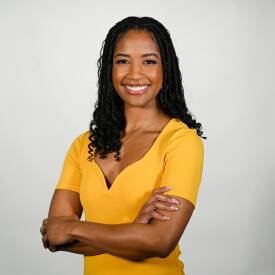
Paris Alston hosts this weekly series that serves up Black intellect, culture and joy. Rooted is based in Boston with a perspective that ranges from communities around the corner to issues and ideas resonating across the globe. This is the place to hear from people who make the news and people who make sense of the news - including you. Tell us what you think and what you’d like to hear on future episodes at Rooted@wgbh.org
Find more content and subscribe to our YouTube channel.