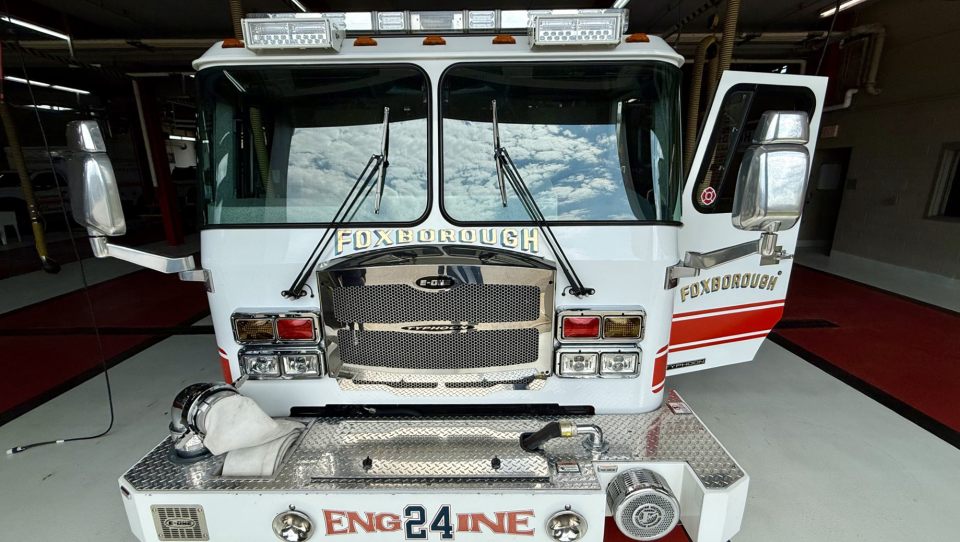

The Revere Fire Department bought two fire engines from a North Attleboro-based dealership about four years ago.
Fire officials said they were told it would take about a year and a half to receive the engines. They’re still waiting.
Even more frustrating, department officials say, they recently saw the trucks on display at the Mohegan Sun casino in Connecticut during a conference hosted by the New England Association of Fire Chiefs.
“If it’s not ready yet, then why are we showcasing it in Mohegan Sun … so they can play ‘touch-a-truck?’” Revere Fire Captain Kevin O’Hara, who is also president of Revere Firefighters Local 926 union, told GBH News recently. “That’s wrong.”
The frustration, which first emerged in social media posts by the local fire department last month, is a sign of a growing concern among fire departments in Massachusetts and across the country about what they say is an increase in both wait times and costs for fire trucks.
Many blame the increasing presence of private equity in the industry for the crisis. Over the past two decades, private equity firms have picked off many smaller manufacturers and taken control of most of the market, critics say.
In recent years, a handful of companies have assumed dominance over the market. Collectively, three companies — REV Group, Oshkosh Corporation and Rosenbauer America — control more than 70% of the U.S. market,according to a June media post by the International Association of Fire Fighters.
Revere bought its fire trucks from a company called Greenwood Emergency Vehicles, which is a dealer for E-One, a global manufacturer of fire trucks. That company is owned by REV Group, which is now part of a publicly traded company, Terex Corporation.
The city of Revere last year filed a class action complaint in U.S. federal court claiming defendants conspired to limit supply and raise costs. The case has been consolidated with others across the country.
Concerned about the issue, Sen. Elizabeth Warren, a Democrat from Massachusetts, co-authored a resolution with other lawmakers in July, urging the Federal Trade Commission to investigate what they called “serial acquisitions of firetruck manufacturers.”
“When giant corporations and Wall Street investors buy up all the fire truck manufacturers, it’s a threat to public safety,” said Warren in a press release. “There’s a growing, bipartisan consensus that Congress must stop a handful of corporations from dominating fire truck manufacturing and making it harder and tremendously more expensive to get fire trucks.”
In a statement to GBH News, Rosenbauer America said that the company strongly disagrees with the claims made in the lawsuit.
“Rosenbauer America will assertively defend itself. Rosenbauer America will not let this distract from doing what we do best — supporting first responders and those they keep safe by delivering cutting-edge firefighting and rescue technology and equipment communities rely on.
In response to questions about the increased manufacturing times and costs, REV Group referred to a September 2025 testimony to a Senate subcommittee from the company’s special vehicles segment president.
“Like most products manufactured in the United States, firefighting vehicles have faced significant inflation of input and manufacturing costs over recent years, including increased costs of labor, raw materials and other inputs,” said Mike Virnig.
“Like others in this highly competitive industry, REV Group has had to raise prices in order to offset these increased costs, so the price for new firefighting vehicles has increased along with such production cost increases,” he continued.
Representatives of Oshkosh Corporation has not responded to questions from GBH News.
A struggle to get new fire trucks
Fire chiefs from around the state told GBH News they are struggling to get new vehicles or cover higher costs, a problem that is especially difficult in smaller, industrial Massachusetts municipalities known as Gateway Cities.
In Brockton, Fire Chief Brian Nardelli said the department bought three new fire engines in 2020 for $630,000 each. Two years later, they bought another for about $800,000. They currently have two engines on order now that will cost $1.1 million.
“They’re taking us to the cleaners,’’ Nardelli told GBH News recently. “For cities like Brockton that are somewhat more socioeconomically declined than other communities, that’s a big deal. And like any other community, like a Fitchburg, like a New Bedford, like a Fall River, Lawrence, or Lowell, you get put into an unfortunate position of now you don’t have the same tax base as you had before.”
Nardelli said this crisis has implications beyond purchasing new trucks. It also affects how departments are able to maintain their existing, aging fleet. Replacement parts, he says, have tripled in price and take twice as long to arrive.
In Fall River, Fire Chief Jeffrey Bacon said his department is forced to keep 30-year-old spare engines and a 40-year-old spare ladder in service because of the rising costs.
Just recently, he said, the Fall River Fire Department had a ladder truck out of service for routine maintenance and a spare ladder truck out with a major malfunction. This left the department that serves a city of nearly 100,000 people scrambling to respond to calls with the correct trucks, he said.
“That’s the reality of what happens,” Bacon told GBH News. “We don’t schedule our fires. We don’t schedule where they are or when they are. It’s always a roll of the dice and it’s always a gamble anytime we’re not at peak capacity.”
In Revere, O’Hara said he’s hopeful their legal case will make a difference.
“We have a strong case and we should win,” O’Hara said. “I’m not against anybody trying to make a dollar, but if you’re doing it ... in the public safety field where lives are at stake, then I have a problem with that.”
As far as the engines they purchased, O’Hara said they were told they would be delivered in a couple of weeks.
“I guarantee we won’t have them until October,” he said. “That’s how it always works out. It’s just constant lies. That’s all it is.”
This story began with a conversation held at a listening session in Fitchburg, part of a GBH News initiative to visit all 26 Gateway Cities this year. Do you have something about your community that you want to share? Email us at equityandjustice@wgbh.org.