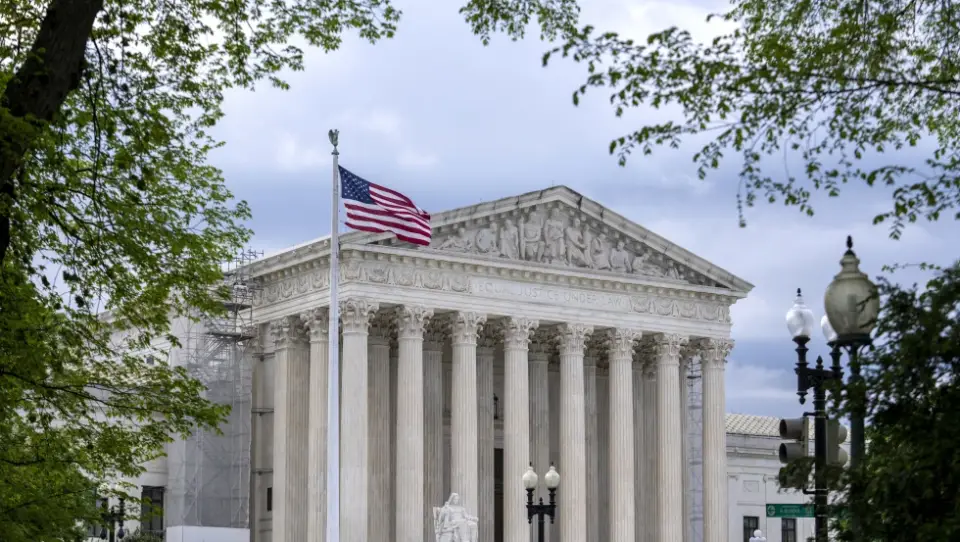

After the Supreme Court’s ruling this week that weakens the country’s most significant voting legislation, Massachusetts voting advocates say the decision will increase resentment of government and threaten democracy.
In Wednesday’s ruling on the case Louisiana v. Callais, the Supreme Court ordered the state of Louisiana to redraw maps that created a second majority-Black district. That district was created in 2024 in order to comply with the Voting Rights Acts of 1965, but in his decision, Justice Samuel Alito called the map an “unconstitutional gerrymander.”
The court’s decision allows for congressional districts prioritize racial demographics to be challenged, and could lead to fewer majority-minority districts, and fewer elected representatives of color.
Congresswoman Ayanna Pressley called the ruling “shameful,” saying the court is “complicit in Republicans’ assault on our democracy and Black political power.”
“This decision will disenfranchise millions of people, further weaken the Voting Rights Act, and embolden racial discrimination in our elements,” said Pressley, who is the only person of color in the Massachusetts congressional delegation.
Traci Griffith, director of the Racial Justice Program at ACLU Massachusetts, called the decision a “slap in the face” to decades of civil rights advocacy, citing the work of Martin Luther King, Jr., and Jesse Jackson.
“If the Voting Rights Act was the act that solidified access for communities of color to the ballot box, the Supreme Court’s decision has basically nullified that,” Griffith said. “It has really torn that down.”
“Voters of color should have a fair say in democracy,” Griffith said. “And politicians shouldn’t be able to choose their voters. Voters should choose their politicians.”
Because Massachusetts is a historically blue state, the effect might not appear at the ballot box the way it does in southern states, Griffith said. However, the decision will have a trickle-down effect on Massachusetts voters, as decisions made at the federal level will affect the funding the state receives.
She said the decision makes it paramount to enact measures such as passing the John R. Lewis Voting Rights Advancement Act to restore parts of the Voting Rights Act, or creating state-specific legislation to protect voting rights.
“What’s going to happen in Louisiana is going to be completely different than what’s going to happen in Massachusetts,” she said. “But we have to control what we can control. We’ve got to fortify ourselves in the ways that we can … within our sphere of influence.”
Local voting rights advocate Ron Bell called the Supreme Court decision a “threat to democracy.”
“The Voting Rights Act is … or was, a beacon of freedom,” said Bell, who is also the founding director of Dunk the Vote, a civic engagement organization that he started in response to police harassment of Black men in the 1980s. “Today, we see it dimmed.”
While not surprised by the court’s decision, Bell says that it deepens resentment and pessimism about the government in communities of color, making his advocacy work even more challenging.
“It’s already hard as it is. People’s needs are not being met like they should, people are struggling in Massachusetts. And this further exacerbates that injustice,” he said.
But as one pillar of democracy weakens, Bell said, “our duty is rise, to vote and reclaim the power that belongs to the people.”
“This is an opportunity for people to really fight back. I feel this is an opportunity for our elected officials and our community to come together and to stand up … for our voting rights,” he said.
This decision is the latest shift in the Voting Rights Act of 1965 since the Shelby County v. Holder decision in 2013, which removed guardrails for states with histories of discrimination to implement new voting restrictions without federal approval.
Griffith said the most recent Supreme Court decision calls into question the country’s commitment to creating a multiracial democracy.
“I don’t want to go back to the 1950s,” Griffith said. “That does not bode well for me as a Black woman. So we have got to fight for this multiracial democracy. We’ve got to keep moving forward and not back.”



