Power the news you rely on!
Support GBH 89.7 today to fund the fact-based journalism and insightful conversations you hear every day. Your gift keeps independent news free and accessible to everyone.
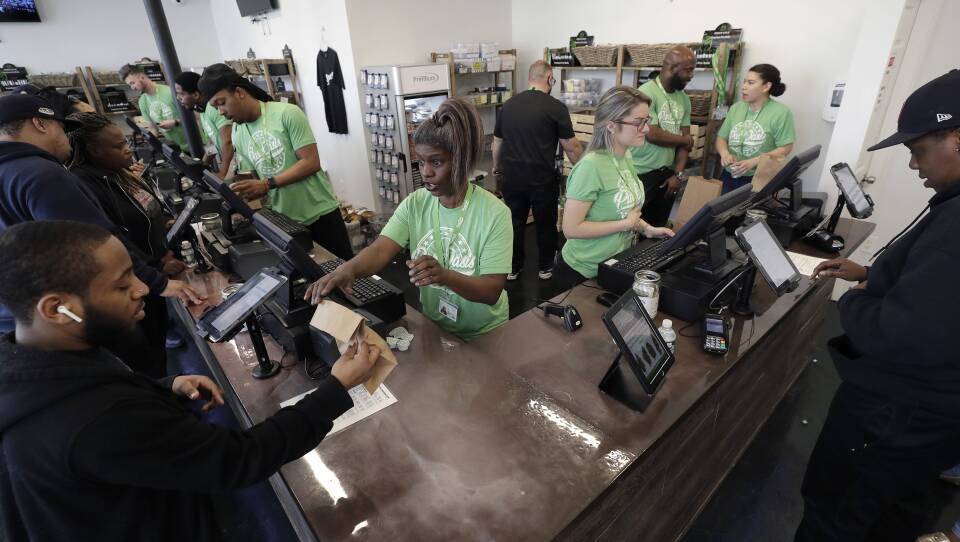

Kobie Evans, co-owner of Boston cannabis shop Pure Oasis, says the state froze his company’s bank account for owing back taxes despite that fact that the business had been approved for a state grant that would have paid it down substantially.
Evans says that the seizure of the bank account by the state’s Department of Revenue forced him to close his business last week. He said the company owed more than $300,000 in taxes.
However, he said his business had applied for and was approved for a $300,000 grant from the Cannabis Social Equity Trust Fund at the time. The fund is a pool of money intended to promote equity within the state’s marijuana industry by giving financial assistance to cannabis entrepreneurs from communities that were disproportionately harmed by marijuana prohibition and enforcement.
“We specifically applied back in December for the grant to go against the taxes,” Evans told GBH News of the trust fund application.
A spokesperson from the state’s Executive Office of Economic Development, which oversees trust fund payments, said Pure Oasis was recently approved for a $300,000 grant. A disbursement process for those funds will begin soon, the spokesperson said.
Last week, Evans said, he and his partner learned that the DOR had decided to freeze the company’s bank account due to the delinquency, and did not offer any process for a potential payment plan.
“We can’t pay people, we can’t order product, we can’t operate, which means we can’t pay the balance,” said Evans. “That kind of bureaucratic insanity was the tipping point for everything.”
The Department of Revenue did not respond to a GBH News request for comment.
But Evans said the action prevented him from being able to pay anyone that day.
“We didn’t want to be in a situation where we had people working and their payment was in limbo down the road,” he said.
Pure Oasis was Boston’s first recreational cannabis dispensary, and the state’s first Black-owned cannabis shop, when Evans and co-owner Kevin Hart opened a flagship store in the city’s Grove Hall neighborhood in 2020. The pair later opened a second dispensary near Downtown Crossing in 2023.
Aside from the taxes owed, the company is also paying a $65,000 debt to a cannabis supplier from a past lawsuit, and is facing another $175,000 lawsuit brought by a construction company over work done on a third store Pure Oasis was planning to open in Brighton, according to Axios.
But Evans downplayed those lawsuits as a factor in company’s financial hardship.
“Usually what happens is that you come to some agreement and you do a payment plan, you pay over time,” he said, describing legal payments as typically manageable. “A lawsuit is something on paper that you ultimately settle, and you pay DOR when they leverage your bank account, you’re stuck, you’re frozen, you can’t do anything. That hits us smaller operators a lot harder than a multi-state operator with multiple locations in a grow facility.”
In the meantime, Evans said the store closures have made him numb.
“I haven’t been able to actualize those feelings yet because we’re in limbo with DOR, and I have 60 staff members that haven’t been paid,” he said.
Evans did not say whether stores will remain permanently closed, but did say he has been processing unemployment claims for employees.
An official with the state’s Cannabis Control Commission, which approves dispensary licenses, indicated that license-holders are not required to immediately surrender their licenses. They can either let them expire or transfer them to another owner.
Cannabis Control Commission Chair Shannon O’Brien said she learned of the situation through news reports, and plans to address ways to help struggling cannabis businesses with action later this week.
“This is one more example of why the Cannabis Control Commission needs to act swiftly over the next several months to help businesses facing significant headwinds with thousands of jobs at stake,” O’Brien said in a statement to GBH News. “At this Thursday’s meeting we will vote to get rid of burdensome and costly regulations that do not protect public health and safety.”
Evans also pointed to a confluence of changing market conditions contributing to the company struggling to pay its bills without outside funding.
“Seeing that our customers just don’t have the same amount of disposable income as prices increase, people don’t have as much money to spend on cannabis,” he said.
That, along with extremely low product prices, recent approvals that cleared the way for larger cannabis operators to move into the Boston market and a newly-approved bill awaiting the Governor’s signature that would bump up the number of licenses a cannabis owner can hold from three to six, “wasn’t a good signal,” for small, economic empowerment operators like Pure Oasis, Evans said.
“Every day it becomes harder and harder, every day staff have to go out and find a new job, every day, staff have to make life choices, and every day you’re not open, that’s income you don’t have.”



