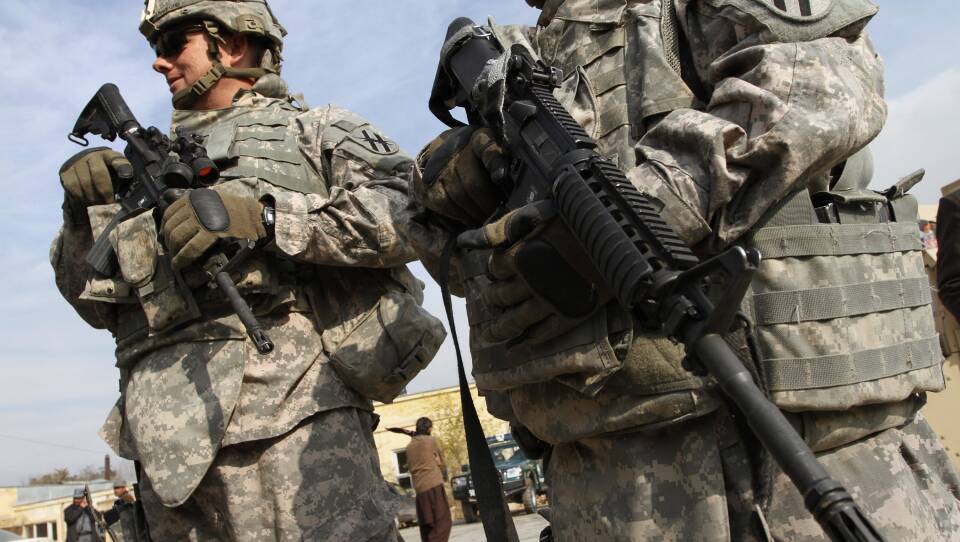
The war in Afghanistan, which has been a burden on three American presidents and is one of the longest-running wars in American history, may be entering its final chapter. Last month, President Donald Trump shocked those within his administration when he abruptly announced his decision to withdraw 7,000 troops from Afghanistan, along with 2,000 troops stationed in Syria, to prevent the spread of ISIS.
The move was so sudden it caused former Secretary of Defense Jim Mattis to announce his resignation over the policy disagreement, and stunned those close to the president. While reducing America’s military footprint has found bipartisan support across the political spectrum, others, like WGBH News Analyst and CEO of the GroundTruth Project Charlie Sennott, are concerned with the suddenness of the decision, and worry it could create more trouble down the line.
“It is a great idea to get out of conflict in the Middle East as much as we can,” Sennott told Boston Public Radio on Monday. “But how the president did it showed absolute disarray in the White House. You can’t announce something like that and not have briefed your secretary of defense or the envoy who you’ve appointed to work with our allies on the defeat of ISIS.”
Sennott, a former Middle East bureau chief for The Boston Globe, is no stranger to the perils of U.S. engagement in the complex ethnic, religious and geopolitical relationships in the Middle East. But, he said, a sudden and stark disengagement with the region will undoubtedly have unintended consequences that could burden the U.S. in the future.
“President Obama also turned his back on the Middle East when he said, ‘We’re going to do the pivot to China,’ which means turn your back on the Middle East, and look what happened,” Sennott said. “We went from the hopes and dreams of a democracy movement known as the Arab Spring, to the War in Syria to the War in Yemen, and to a disastrous return of a police state in Egypt.”
Domestically, Trump’s decision will further strain his relationship with the State Department, along with many in the Pentagon who in the preceding weeks stated the United States had no intention of pulling troops out of Syria.
Meanwhile, the decision has managed to upset key U.S. allies, such as the United Kingdom and France, who currently have troops deployed in Syria and Saudi Arabia, Israel and Jordan and who all had a vested interest in America’s role in containing and rolling back ISIS troops.
Though Trump is calling for an immediate withdrawal of all troops, the president’s national security adviser, John Bolton, contradicted the president on Sunday, when he told reporters in Israel that the U.S. would remain in Syria until ISIS is defeated. As for now, Trump has given a tentative withdrawal date of Jan. 18., and despite Bolton’s statements, said he has no intention of reneging on this decision.



