-

Tea: Consumption, Politics, and Revolution, 1773–1776
Join Revolutionary Spaces at the Old South Meeting House for a discussion with Dr. James Fichter of the University of Hong Kong to mark the publication of his new book Tea: Consumption, Politics, and Revolution, 1773–1776. Dr. Fichter is joined in conversation with Dr. Nathaniel Sheidley, President and CEO of Revolutionary Spaces.
In his new book, Dr. Fichter reveals a new dimension of the Boston Tea Party by exploring a story largely overlooked for the last 250 years—The fate of two large shipments of East India Company tea that survived and were drunk in North America. The book challenges the prevailing wisdom around the tea protests and consumer boycotts while showing the economic reality behind political rhetoric: Colonists did not turn away from tea as they became revolutionary Americans. While history records the noisy protests and prohibitions of patriots, merchant ledgers reveal that tea and British goods continued to be widely sold and consumed.
By bringing different locations and events into the story and reinterpreting old ones, Dr. Fichter shows how the continuing risk that these shipments would be sold shaped colonial politics in the years ahead. He also hints at the enduring potency of consumerism in revolutionary politics.
This program is made possible by the generous support of The Lowell Institute.Partner:Revolutionary Spaces -
James Fichter
JAMES FICHTER is Associate Professor of European and American Studies at the University of Hong Kong, where he teaches courses on maritime history, the revolutionary Atlantic, and World War I. Fichter is also the author of So Great a Profit: How the East Indies Transformed Anglo-American Capitalism (Harvard, 2010) and editor of British and French Colonialism in Africa, Asia and the Middle East: Connected Empires across the Eighteenth to the Twentieth Centuries (Palgrave, Cambridge Imperial and Post-Colonial Studies, 2019), as well as author of various articles. His next monograph, Suez Passage to India: Britain, France, and the Great Game at Sea, 1798-1885, examines the interconnections between the British and French Empires in Asian waters, from Napoleon’s invasion of Egypt in 1798 to the Sino-French War in 1885. He received a BA in history and international studies from Brown University in 2001, and a Ph.D. from Harvard University in 2006. -
Benjamin Taylor with Chasing Bright Medusas: A Life of Willa Cather
Celebrating one of America’s greatest female novelists, this biography brings to life Willa Cather -- her artistry and endurance, her immigrant family and the prairies on they lived, and her trailblazing success as a journalist and writer.
In the early 20th century, Willa Cather leapt into the forefront of American letters with the publication of her novels O Pioneers! (1913), The Song of the Lark (1915), and My Antonia (1918). At the time, she was well into middle age. Her success followed years of working in journalism in Nebraska, brief spells of teaching, and editorial work on magazines. Chasing Bright Medusas is her story told by of another mature and highly accomplished writer, the award-winning biographer Benjamin Taylor, a lifelong lover of Willa Cather’s work. Taylor’s elegant exploration of her artistic endurance and of her early years and family, bring us back in time to portray vividly the challenges of being an immigrant family, a woman, and a literary trailblazer -- one the greatest authors of the twentieth century.Partner:American Ancestors Boston Public Library -
Empire and Its Discontent: Could the Empire Have Been Saved?
The approach of the 250th anniversary of American independence has led scholars to reexamine the British Empire and the events of the imperial crisis that are generally understood to have led to the American Revolution. The panelists of the keynote session “Could the Empire Have Been Saved?” engage this issue by discussing the problems in the empire revealed by resistance to imperial authority in British America between 1764 and 1774. What kind of empire was it? What was the character of British policy in the colonies? Was the imperial crisis really a general crisis that touched all colonies and all members of British American society? What was driving events forward? Was the American Revolution really inevitable? And might better decisions have avoided it? In engaging these questions, the panelists aim to reveal the broader implications of new thinking about the British empire and the coming of the American Revolution.
This keynote is part of the conference on the theme "Empire and Its Discontent" hosted by The David Center for the American Revolution at the American Philosophical Society and the Massachusetts Historical SocietyPartner:Massachusetts History Society -
Christopher Brown
Christopher Brown is a historian of Britain and the British empire, principally in the seventeenth and eighteenth centuries, with special emphasis on the comparative history of slavery and abolition, and with secondary interests in the Atlantic Slave Trade and the Age of Revolutions. His current research centers on the history of European experience on the African coast at the height of the Atlantic slave trade, and continues early commitments to the rise and fall of slavery in the British Empire. Published work has received prizes in four distinct fields of study – American History, British History, Atlantic History, and the history of Slavery, Abolition, and Resistance. Completed projects include Moral Capital: Foundations of British Abolitionism (University of North Carolina Press) and, with Philip D. Morgan, Arming Slaves: Classical Times to the Modern Age (Yale University Press). He has written as well for The Nation, The New York Times, and the London Review of Books, among other outlets. -
Patrick Griffin
Patrick Griffin teaches history at Notre Dame. He also directs the Keough-Naughton Institute. He has written a number of books on eighteenth-century Atlantic history, empire, and the era of the American Revolution. His most recent is: The Age of Atlantic Revolution: The Fall and Rise of a Connected World, which came out with Yale University Press. -
Serena Zabin
Serena Zabin is a historian specializing in early American history, with a focus on the American Revolution. Her acclaimed book, 'The Boston Massacre: A Family History' (2020), offers a fresh perspective on the event by revealing the personal and social ties between British soldiers and Boston’s residents. Through rich archival research, she challenges traditional narratives, emphasizing the interconnected lives of civilians and military families. A professor at Carleton College, Zabin has significantly contributed to the study of Revolutionary America, blending social and political history to deepen our understanding of colonial society and the conflicts that shaped the nation’s founding. -
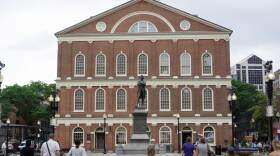
Boston City Council emphatically backs renaming Faneuil Hall
The proposal received overwhelming support from a body that’s frequently divided. -
Ask The Expert: The Real Thanksgiving Story
We think we know what happened in 1621 — why Thanksgiving was held, how the Wampanoag were invited, what the Pilgrims ate – but first Thanksgiving facts, as most Americans have been taught in the years since, are not exactly accurate.
Learn more about the real Thanksgiving story, as shared by Brad Musquantamôsq Lopes (Aquinnah Wampanoag), Director of Wampanoag and Indigenous Interpretation and Training at Plimoth Patuxet Museums and Tom Begley, Deputy Director of Collections, Research, & Public Engagement at Plimoth Patuxet Museums. Together, Brad and Tom will offer historical and cultural perspectives related to the first Thanksgiving story and gratitude as a way of life for Indigenous Peoples. Topics to be explored include:
- The historical events that led up to the “First Thanksgiving” feast
- Who sat at the table
- What food was served
- How long the feast lasted
- Traditions of gratitude that informed Thanksgiving
- How Thanksgiving has been observed from 1621 to today
Don’t miss this unique opportunity to separate fact from fiction with our experts, and gain a deeper understanding of the real Thanksgiving story.
More about our speakers
Brad Musquantamôsq Lopes is the Director of Wampanoag and Indigenous Interpretation and Training at Plimoth Patuxet Museums, located in the homelands of his people, the Wampanoag Nation. A proud citizen of the Aquinnah Wampanoag community with a degree in Secondary Education from the University of Maine at Farmington, Brad has worked as a classroom teacher, curriculum developer, and most recently as a Program Director for the Aquinnah Cultural Center on Noepe (Martha’s Vineyard). In this role, Brad oversees the Wampanoag and Indigenous training program and the implementation of interpretive content and techniques surrounding the understanding of Indigenous people both in the past and today.
Tom Begley is the Deputy Director of Collections, Research, & Public Engagement at Plimoth Patuxet Museums. He has been with the museum since 2014 and has a Bachelor's degree in U.S. History from Stonehill College and is completing his Master's degree in Public History at UMass Boston. In his current role, Tom directs the research facilities and the operations across the exhibit and living history spaces. He served as editor on the facsimile of William Bradford's Of Plimoth Plantation published in collaboration with the State Library of Massachusetts and guided Plimoth Patuxet's successful application to list Mayflower II on the National Register of Historic Places.
About Plimoth Patuxet
Plimoth Patuxet is one of the nation’s foremost living history museums. Founded in 1947, the museum creates engaging experiences of history built on thorough research about the Indigenous and European people who met along Massachusetts' historic shores in the 1600s. Immersive and educational encounters underscore the collaborations as well as the culture clash and conflicts of the 17th century people of this region. Major exhibits include the Historic Patuxet Homesite, the 17th-Century English Village, Mayflower II, and Plimoth Grist Mill.
More about Ask the Expert
At Ask the Expert, get access to experts specializing in a wide variety of topics, learn something new about a subject you are passionate about or discover a new interest. GBH invites you to drive the conversation by asking questions during the live event directly with our expert. It’s always interesting, and it’s always free!
This event is presented in partnership with Plimoth Patuxet Museums.
Photo credit: Kathy Tarantola/Plimoth Patuxet MuseumsPartner:GBH Events -
New Salem Witch Trials exhibit focuses on victims' stories
The Peabody Essex Museum's "Salem Witch Trials: Restoring Justice" showcases real objects and letters tied to the people involved.