EXPLORE MORE
Monday on BPR:
Boston Globe’s Shirley Leung on the business of the World Cup
Sports physician Kate Ackerman from the Women's Health & Sports Performance Clinic
Tufts food policy analyst Corby Kummer
Stephen Rich of UMass Amherst for a FAQ on staying safe during this tick season
Recent segments
-

Andrew Yang On Why The Stimulus Checks Aren't Enough
The presidential candidate who ran on the promise of a universal basic income is calling for recurring checks during the coronavirus pandemic. -
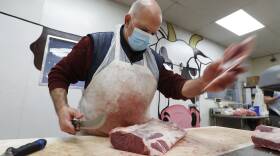
'Social Distancing Is Impossible' In Meat Packing Plants, Says Corby Kummer
Working conditions within meat packing plants require close quarters to colleagues, says Kummer. -
Charlie Sennott: ‘It’s Time to Fight Like Hell’ To Protect Press Freedom
The WGBH news analyst weighed in on the myriad of factors threatening journalism both in the U.S. and around the world. -
Travel Writer Rick Steves, Grounded By The Coronavirus, Says 'There's More To Life Than Being Productive'
Steves is stuck at home for now, but is keeping his company going so they can jump right back in when pandemic passes. -
'Never Have I Ever' Show Is 'Perfect' For Uncertain Times, Says Bob Thompson
The charming new Netflix show is a comforting during the pandemic, Thompson says. -
'Social Distancing Is Working' In Massachusetts, Says Dr. Benjamin Linas
Massachusetts has flattened the curve, but has only seen a plateau of COVID-19 cases, not yet a decline.



Listen to previous shows
-
BPR Full Show 12/23/19: Maura Healey Weighs In On The Sacklers 'Ill Gotten Gains'
Today on Boston Public Radio: Jennifer Nassour and Steve Kerrigan joined us for a politics roundtable. Nassour is a former Chair of the MassGOP and COO of ReflectUS, and Kerrigan is President and co-founder of the Massachusetts Military Heroes Fund, and former CEO of the DNC. TV writer Bob Thompson reviewed Eddy Murphy’s return to SNL, FX’s “A Christmas Carol”, and the bevy of options for online Yule log viewing. Medical ethicist Art Caplan discussed a new test to diagnose Alzheimer’s, and a Wayne State University study on society’s attitudes surrounding infidelity. Reverends Irene Monroe and Emmett Price III, hosts of WGBH’s All Rev’d Up, discussed an editorial in Christianity Today calling for the removal of President Trump, and a 16 year prison sentence for a man who burned an LGBT flag. Attorney General Maura Healey stopped by the Boston Public Radio studio for our monthly “Ask the AG” series. -
Boston Public Radio Full Show 12/20/19: Actually, Love Actually...
Today on Boston Public Radio: We opened the lines to callers to hear about your favorite holiday traditions. Emily Rooney, host of WGBH News' Beat The Press, joined us for her famous list of fixations and fulminations. Boston Mayor Marty Walsh joined for our monthly edition of “Ask The Mayor.” He discussed updates to the Trust Act, new space-saver rules for the winter, and his views on Rep. Ayanna Pressley’s push to decriminalize prostitution. Boston Globe columnist Shirley Leung discussed a Waltham holding company adding a female director to its all-male boardroom, and why she thinks Gov. Charlie Baker ought to put his plans to sell Hynes Convention Center on pause. Under the Radar host Callie Crossley discussed a smartphone app to help parents find Black Santas, and holiday movies to watch if you’re avoiding the Hallmark channel. David Waters and Brian Hillmer from Community Servings joined us for a year-end news quiz. -
Boston Public Radio Full Show 12/19/19: Prune Chicken for the Holidays
Today on Boston Public Radio: Rep. Joe Kennedy called in to discuss yesterday’s impeachment vote, and his thoughts on the value of the electoral college. Former Suffolk County Sheriff and Secretary of Public Safety Andrea Cabral discussed yesterday's impeachment vote and a recent interview with Harvey Weinstein in the New York Post. Massachusetts Governor Charlie Baker joined us for our monthly “Ask the Governor” segment. Harvard law professor Martha Minow discussed her new book “When Should Law Forgive?” Christopher Kimball, founder of Christopher Kimball’s Milk Street, discussed his new book, “Milk Street: The New Rules: Recipes That Will Change the Way You Cook" We opened our lines to callers to hear about your unusual and bizarre holiday recipes. -
Boston Public Radio Full Show 12/18/19: Impeachment Day
Today on Boston Public Radio: We aired live audio from the House impeachment debate and discussed the proceedings with callers. -
The Top 5 Cookbooks From 2019 According to Corby Kummer
Food writer Corby Kummer took Boston Public Radio behind the scenes of his end-of-year list of the best cookbooks on Tuesday. The list appears in The Atlantic and is a diverse collection of food literature. "I tried for cultural variety, I tried for something that's educational, and I tried for something we don't know, I don't know, in addition to the cook book literature," he said. "The ones I picked were stuff I didn't know about, and was so excited to learn." Kummer described one of his selections, "Jubilee: Recipes From Two Centuries of African American Cooking" by Toni Tipton-Martin, as more than a cookbook, but a piece of "deep scholarship." "She decided to do a beautiful out and out picture book," he said. "The whole book was delayed two years because of her insistence that the food stylists and photographers be African American. It's been so hard for them to break into the publishing biz and food styling biz. It took a long time, the publisher was willing to wait, they did it, and it's a gorgeous book." Corby Kummer is executive director of the Food and Society policy program at the Aspen Institute, a senior editor at The Atlantic and a senior lecturer at the Tufts Friedman School of Nutrition Science and Policy