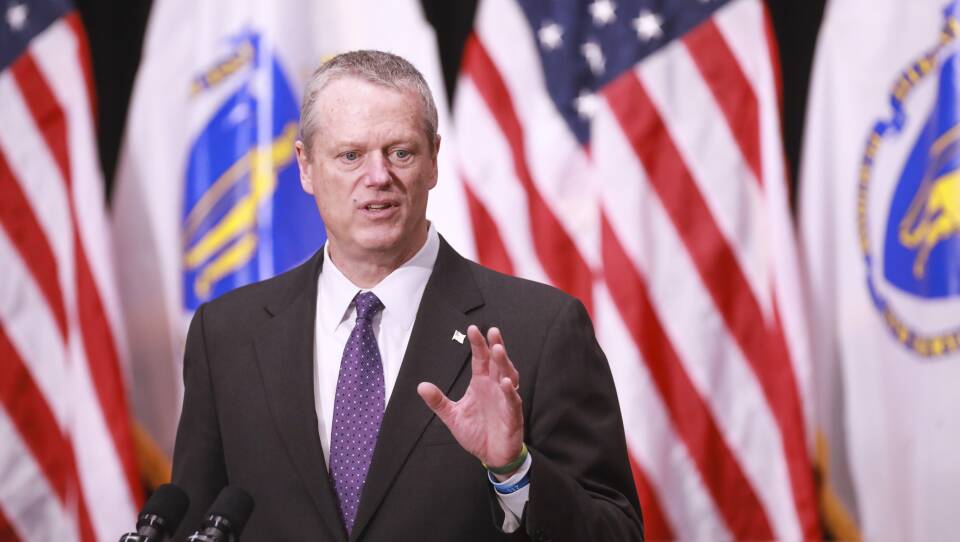

At the close of the weekend, about 287,000 doses of the COVID-19 vaccine had been shipped to providers in Massachusetts, and nearly 117,000 doses of the vaccine had been administered, Gov. Charlie Baker announced Tuesday.
Baker, who provided those figures in a vaccination briefing at Baystate Medical Center in Springfield, said those numbers are likely higher given predictable delays in reporting.
“It always takes a few days for these numbers to be reported to DPH by providers,” Baker said.
So far, 74 of the state’s 76 hospitals have begun vaccinating COVID-facing staff, with over 70,000 staffers vaccinated so far, Baker added.
Baker was joined at the briefing by Mark Keroack, the president and chief executive officer of Baystate Health, which serves more than 800,000 people in Western New England.
In the Baystate system, Keroack said, 12,252 staff members have been invited to receive the vaccine, with priority given to staff in COVID-facing units.
Of those, about 7600 have responded. Roughly 6200 have received the first dose, and some are receiving the second dose.
Nearly 1,500 people have declined to be vaccinated, Keroack said — but of those, more than 60 percent are open to doing so in the future after they see the vaccine’s effects on their colleagues.
To date, Keroack said, those effects have been mild.
“Mild sore arms are common,” he said. “Occasional flu symptoms are surprisingly uncommon — only two percent of people. There have been a few allergic reactions, fewer than ten, that have been successfully treated using standard treatments.”
Keroack called concerns about the rapid development of COVID vaccines “kind of curious,” noting that during the early years of the HIV/AIDS crisis — during which he worked as an infectious-disease specialist — the lack of effective treatment was a source of despair for patients and caregivers.
“AIDS as a disease was described in 1981,” he said. “We didn’t even understand that it was a virus until 1983, and didn’t even have our first effective medicine until 1985. And so that was a long, sad wait when we had nothing to offer patients, and really didn’t know what was going on.”
While there’s widespread reluctance to accept the recommendations of experts in our current historical moment, Keroack added, the public at large would benefit greatly from getting the COVID vaccine when it’s available.
“It’s almost amusing to me that we, in the infectious-disease community, spend our days prior to the pandemic twisting people’s arms to take a flu shot — a vaccine which is anywhere from 40 to 70 percent effective, 70 percent on a really good year,” he said. “This particular vaccine is 95 percent effective. So it’s a real home run.”



