Power the news you rely on!
Support GBH 89.7 today to fund the fact-based journalism and insightful conversations you hear every day. Your gift keeps independent news free and accessible to everyone.

This is a web edition of GBH Daily, a weekday newsletter bringing you local stories you can trust so you can stay informed without feeling overwhelmed.
🌤️Mostly sunny with highs in the 60s. Sunset is at 6:18 p.m.
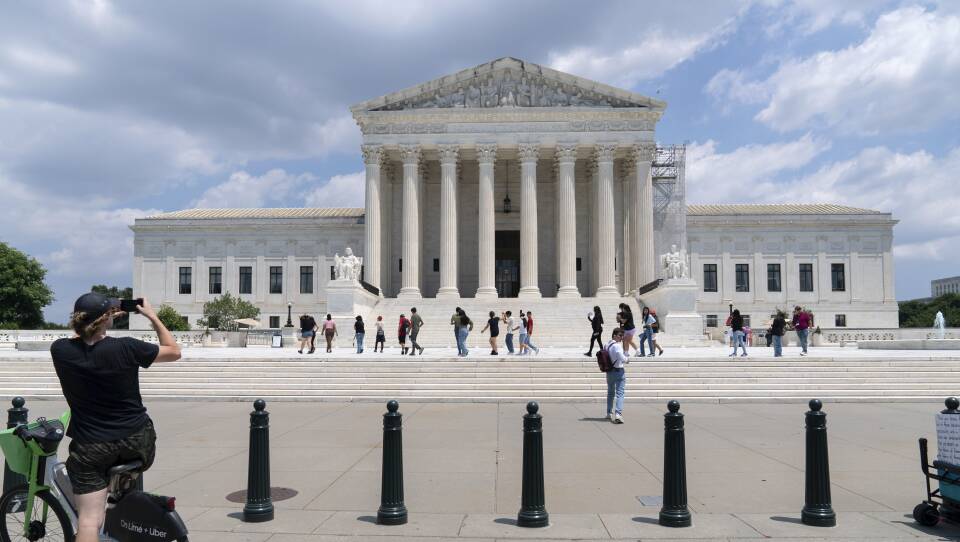
Last week the U.S. Supreme Court allowed the Trump administration to again start sending immigrants who were ordered deported to countries they are not from, and in many cases have never been to. This practice is called third-country deportation.
Two of the four plaintiffs in the case now making its way through the court system are Massachusetts residents. Other Massachusetts residents not involved in the lawsuit also told GBH’s Sarah Betancourt they’ve seen the practice up close. She spoke with one man from a North African country who was in ICE detention in Plymouth and said he felt pressure to either agree to return to his home country or face deportation to a place he’s never been.
“They would keep saying, ‘Oh, you’re from Africa, so it might be Uganda.’ They were telling me like, ‘You can be in Uganda.’ I was like, ‘Man, I don’t speak the language. You can’t just send me there,’” he said. He ended up taking neither option and was ordered released. He’s now back with his family in Massachusetts. Betancourt breaks down the history of this legal case and the stories of more people involved here.
1. Strike date set at Brigham: About 4,000 nurses at Brigham and Women’s Hospital in Boston said they will go on an indefinite strike starting Wednesday, Oct. 14, unless their union can reach an agreement with hospital management. The nurses want pay raises, smaller increases in the cost of their health insurance and the hiring of more permanent workers to limit the use of temporary travel nurses.
“We have repeatedly tried to get MGB [Mass. General Brigham] to negotiate and avoid a second strike, but the billionaires who run MGB have shut the door on us,” said Kelly Morgan, a labor and delivery nurse and chair of the Brigham bargaining committee. “There is still time to reach an agreement that protects patient care and respects nurses.”
2. Minogue makes his case: Mike Minogue, the Republican nominee for governor, said he’d cancel a $2 billion project to build a new courthouse in Springfield if elected governor. “It does not cost $2 billion to build a courthouse,” Minogue said. “That’s $1.5 billion in savings right there. That’s two years that we can suspend the gas tax.”
Minogue said he’s “beholden to no party and no political establishment,” though he has previously supported President Donald Trump. “As the governor, I will do what’s in the best interest of the people,” he said, “If D.C. does something that’s good for the state, then I’ll support it. If they do something bad, I’ll fight it.” The election is Nov. 3.
3. New laws proposed for survivors of clergy abuse: Massachusetts Attorney General Andrea Joy Campbell’s office suggested three new laws that would provide more options to survivors of clergy sexual abuse who want to bring their cases to civil court.
The proposals are:
4. We’ll cross this bridge when we build it: Three teams are on the shortlist for a $1.6 billion job: building a new Sagamore Bridge. Each team is made up of multiple companies partnering to complete the project. The state will pick a winner sometime next year, and construction is set to begin in 2027.
“Our existing bridges were the top bridges of their time. Unfortunately for us, that was in the 1930s,” State Sen. Dylan Fernandes said. “This is the biggest project in our region’s history since the creation of the canal well over a century ago.”
This small town librarian is mobilizing against big tech
Hannah Cyrus is a digital librarian at the Bangor Public Library in Maine. She started noticing that her patrons were coming to her confused, curious and frustrated about the AI features that kept popping up on their phones and computers.
“I designed a class that kind of goes over what is generative AI, how probability models work under the hood, what are some of the big concerns that people have with them,” Cyrus told Zoe Mathews on Not My Politics. “And then a very practical, hands-on section of, ‘okay, you wanna turn it off on your Gmail? Here’s how to go in, and what boxes to check or uncheck.’”
Her workshops have titles like “Avoiding AI” and “Breaking Up With Big Tech.” She said she sees the movement to push back against big technology companies with cautious optimism. People getting tired of their search engines or social media platforms becoming harder to use — say, when they have to scroll past an AI summary that does not answer their question or provides misinformation — is “motivating people to finally take plunges that they’ve thought about for years,” such as switching to a search platform with stronger privacy protections.
Dig deeper:
-Mass. Governor Healey went all in on AI. Is it time for her to backtrack?
-Is the Democratic Party losing its appeal with young voters?
-What happens when the adults let racism take the court