

The National Institutes of Health agreed this week to evaluate grant applications that had been denied or stuck in limbo as a result of the Trump administration’s ideological targeting of research grants.
The move is part of agreements made in two separate lawsuits filed in federal court: one by Massachusetts Attorney General Andrea Joy Campbell and 15 other state attorneys general; and a second case from the ACLU of Massachusetts, Protecting Democracy and other plaintiffs, including individual researchers.
In June, Judge William Young of U.S. District Court in Boston ruled the government broke the law by terminating research grants because they related to diversity, transgender issues, and other areas of research disfavored by the Trump administration.
The government appealed that ruling to the Supreme Court, which ruled in August that the district court likely lacked jurisdiction to review the termination of those research grants. At the same time, though, the Supreme Court did not stay the ruling that the directives the NIH used to make those terminations were unlawful.
An appeal on Judge Young’s ruling will be heard in the First Circuit Court of Appeals on Jan. 6.
Over the last several months, the NIH has restored funding to many of the terminated grants. But some grant applications that had been delayed, denied or administratively withdrawn were stuck in limbo.
The agreements reached this week commit the U.S. Department of Health and Human Services to resume its usual process for considering pending NIH grant applications, and limit NIH from applying the disputed ideological directives while reviewing applications for new grants.
“This stipulation means that NIH will be reviewing these applications based on scientific merit and not on the basis of unlawful policy directives that had elevated political ideology over science,” said Olga Akselrod, senior counsel at the ACLU’s racial justice program.


When asked about the agreements, a spokesperson for the NIH responded with a brief written statement.
“NIH cannot comment on the status of individual grant applications or deliberations,” the statement reads. “The agency remains committed to supporting rigorous, evidence-based research that advances the health of all Americans.”
In a press release announcing the agreement with the attorneys general, Campbell said the NIH’s stalling of the review process stole hope from families counting on research into Alzheimer’s disease, cancer and other illnesses.
“This agreement ensures that critical medical research projects are able to continue, paving the way for lifesaving medical advancements, driving job creation, and fostering academic competitiveness at Massachusetts’s world class research institutions,” Campbell said in a written statement.
At the time the lawsuit was filed, the University of Massachusetts had 353 applications for NIH funding whose review had been delayed, totaling millions of dollars in potential funding, according to Campbell’s office.
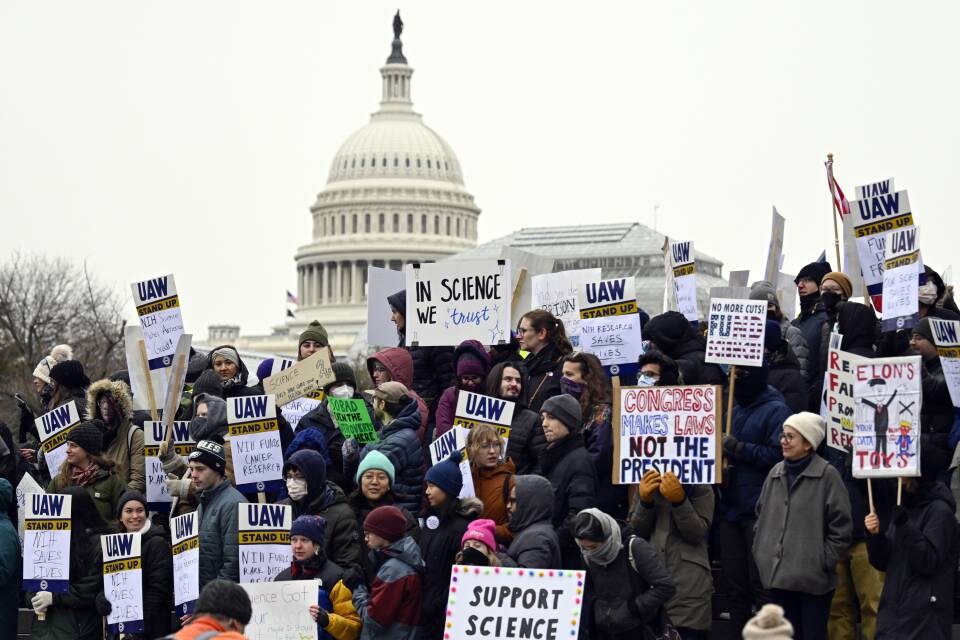
“NIH’s unprecedented actions to implement unlawful directives earlier this year put many scientists’ careers in limbo, including hundreds of members of the American Public Health Association and the UAW union,” Jessie Rossman, legal director for the ACLU of Massachusetts said in a written statement. “This agreement allows them to move forward after months of uncertainty and ensures that each grant application from the plaintiffs and their members receives a good-faith, scientifically rigorous review without reference to the unlawful directives.”
“This agreement marks another important step toward restoring trust in our public institutions,” Kenneth Parreno of Protect Democracy said in a statement.



