

Disabled MBTA riders faced a “harrowing” experience 20 years ago: Broken elevators, malfunctioning wheelchair lifts, inconsiderate bus drivers, platform gaps so large a wheel on a wheelchair would fall through. Only 60% of T stations were accessible.
“Just getting somewhere was just a pain,” said Joanne Daniels-Finegold, a wheelchair user.
Decades ago, Daniels-Finegold, a small group of disabled riders, Greater Boston Legal Services and the Boston Center for Independent Living sued the MBTA in a class action lawsuit for failing to accommodate disabled riders.
The case resulted in a major 2006 settlement, legally binding the MBTA to measures like upgrading buses, improving operator training and more efficiently handling complaints.
Now, legal oversight of the agreement has come to an end. After 19 years, nearly every one of the settlement’s 200 requirements has been met. More than four in five T stations are accessible.
Though the MBTA reached the end of the agreement this week, officials say it’s not the end of their commitment to making the T more accessible.
Those plaintiffs and lawyers Wednesday were emotional as they reflected on decades of advocacy that led to the “sweeping” overhauls in the Boston-area transit system. They cried and hugged as they passed around the documents and signed them.
Daniels-Finegold said that she saw progress within a few months of signing the settlement, when the T rolled out a whole new fleet of accessible buses.
“It was like a whole new world,” Daniels-Finegold said.
Many disabled riders agree, especially when it comes to MBTA workers. MBTA officials say that in 2005, 11% of disabled bus riders were being denied service by a bus operator — in 2024, it was less than 0.5%.
“Now it’s much, much, much, much better. I think the training is much better,” Reggie Clark, one of the plaintiffs in the case, told GBH News.
In 2005, on one out of every five trips, a disabled rider couldn’t board a bus because of a broken ramp or lift. Now, that is close to 0%. And while the most-used elevators were broken the majority of the time in the early 2000s, elevators now operate 99.4% of the time.
The plaintiffs’ persistence has led to a “dramatic shift” in how the MBTA operates, says Taramattie Doucette, a lawyer with Greater Boston Legal Services who has worked on the case since the late 1990s.
“We started off as adversarial, and then we shifted into this very, very collaborative stance,” Doucette said. “We’re all on this mission, on the same goal: make the MBTA accessible.”
The agreement is “historic,” MBTA General Manager Phillip Eng said at a press conference following the signing.
“The passion that the plaintiffs had and their concerns about not only making the system that was not accessible in 2002 and 2005 into one of the best accessible systems in the nation — is about paying it forward,” he said. “This is constantly the mindset: of making accessibility something that is at [the] forefront of everything we talk about.”
A change in culture
The settlement led to the creation of the Department of System-Wide Accessibility, which will now become a permanent part of the MBTA.
“We can say without a doubt that we are one of, if not the most, accessible major transportation system in the country. And there is a lot of pride that comes along with that,” said Laura Brelsford, the department’s assistant general manager.
Breslford, a wheelchair user, recalled “daunting” commutes when she first moved to Boston in the early 2000s, regularly encountering broken elevators and having to add up to an hour to her commute every time. She praised the plaintiffs for pushing the T to embrace accessibility.


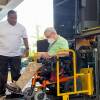
“There was a lot of resistance in the very early years, and [I’m] very happy to say that that gradually shifted pretty dramatically,” Brelsford said.
Legally blind rider Andy Forman, another plaintiff, said he often worried he would be late or miss a train on his commute from Quincy into Boston. He had to memorize his routes and count stops, since he couldn’t rely on audio announcements.
“The main thing that [has] changed for the better is the culture of the MBTA,” Forman said. “The self-confidence that I as a legally blind man ride with, whether it’s the commuter rail or the buses or the subway, is just much better.”
Moving forward
There is still work to be done, advocates say. At a public MBTA meetingin June, Judge Patrick King said that stop announcements have improved — 98%, 95% and 93% on the Orange, Blue and Green Lines respectively. The Red Line lags behind at 79% because of the age of its cars, many of which are more than 50 years old.
Over the next few years, Brelsford said her department is continuing to work on improvements: making many more stops on B and C branches of the Green Line accessible, and bringing station accessibility up to 93% in the next five years. Work will also continue on Commuter Rail stops, improving elevator access at Downtown Crossing, using bus-mounted cameras to automatically ticket cars who block bus lanes and implementing better coordination between municipalities to improve snow clearance at bus stops.
Riders’ Transportation Access Group, a citizen advisory committee, will take on the oversight of the Next Generation Accessibility Agreement along with Boston Center for Independent Living.
Bill Henning, executive director of Boston Center For Independent Living, says it’s inheriting a “a major responsibility trying to carry on a lot of this work, which I think we’ll be up to.”
The disabled riders are hopeful that they can keep the momentum going. Mic Cepeda, a lawsuit plaintiff, has hope for the future: “Making sure people understand that RTAG and the MBTA is not only here for people with [a] disability, but for everybody who needs a ride, who needs to get from point A to point B.”



