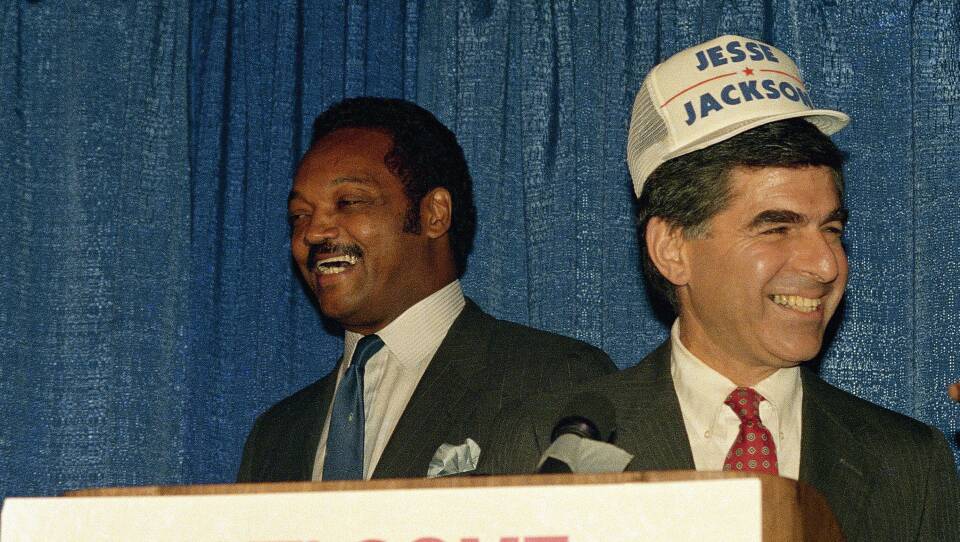

After Jesse Jackson’s death, former Massachusetts Gov. Michael Dukakis put out a brief statement through his son on Facebook. “I was sorry to hear this,” Dukakis said. “Jesse inspired a lot of people. I think ‘Keep Hope Alive’ in 1984 and 1988 did help lead to ‘Yes We Can’ in 2008. That’s an important legacy.”
That statement, which suggests that Jackson’s two presidential campaigns paved the way for Barack Obama to become the first Black president, came nearly four decades after Dukakis beat out Jackson for the Democratic Party’s 1988 presidential nomination. It credited Jackson with bending the arc of history — but didn’t speak to what was, by all accounts, a complex relationship between two highly ambitious men.
“They wanted America to get to the same place,” said Michael Frisby, who covered Jackson’s 1988 campaign for the Boston Globe. “Good jobs for working people. Basically for racial harmony. Basically for equity. And it’s just that they took, their roots took them in different directions in trying to get there.
“They were so different,” Frisby added. “And because of the environment that they were in, with that push of the Democratic Party to the right, and Jackson fighting for the left … they just weren’t able to click.”
That disconnect may have stemmed from substantive and stylistic differences: Dukakis ran as a centrist technocrat, while Jackson campaigned as a progressive populist. But it may also have been because their end goals were different, especially after Dukakis clinched the nomination that June.
Other candidates in the Democratic field, including Al Gore and Richard Gephardt, effectively ended their bids after being mathematically eliminated. But Jackson continued campaigning in earnest, with his efforts culminating in a bus trip from Chicago to Atlanta in the run-up to the Democratic Convention in July. At the convention, Jackson gave a now-famous speech that Jack Corrigan, Dukakis’ deputy campaign manager, recalls moving even Dukakis staffers to tears.
“We were trying to do different things,” Corrigan said. “Jesse was trying to build a movement. And we, Dukakis’ campaign, was trying to come back from a fairly epic defeat in 1984 and build an electoral majority.”
In unguarded moments, the disconnect between Jackson and Dukakis could manifest itself as outright hostility. During that pre-convention bus trip, Frisby recalls being seated back to back in a restaurant next to Jackson, the governor of Tennessee, and the chair of the Tennessee Democratic Party. Frisby was effectively rendered invisible by a large divider that separated their two tables, allowing him to roll his tape recorder as the three men bashed Dukakis at length.
“They talked about how much they hate Dukakis,” Frisby recalled. “And basically, what they’re saying is, it’s just so hard to talk to Dukakis because he thinks he’s so damn smart … They just feel like he didn’t listen to them, that here’s so much he doesn’t understand about politics and about people. I mean, it was a trashing.” (Jackson’s comments yielded a front-page story in the Globe.)
In addition, Jackson was slow to concede in defeat, sent mixed messages about whether he hoped to be considered as Dukakis’ running mate, and engaged in protracted negotiations about what it would take for him to campaign for Dukakis in the run-up to the general election.
“[Dukakis’] aides had this recurring question — ‘What does Jesse want?’” said Ken Cooper, who covered the Dukakis campaign for the Knight Ridder newspaper chain. “Meaning, what does he want so that after the convention he’ll come aboard, unify with the party, and campaign on Dukakis’ behalf to motivate Black voters and his other Rainbow Coalition voters to support Dukakis? … I think ‘frustration’ is the right word.”
If their politics, styles and goals were different, so were their backgrounds. Jackson’s outlook was shaped by his childhood in Jim Crow South Carolina, his subsequent years in Chicago, and his immersion in the Civil Rights Movement. Dukakis, in contrast, grew up in Brookline and made his political bones on Beacon Hill, where he served as a state representative and two-time governor.
Late in the primary campaign, shortly before the convention, the two men’s starkly different sensibilities came to the fore at a July 4th dinner at Dukakis’ Brookline home. According to a New York Times account, the menu included New England clam chowder, salmon with peas, and chocolate torte — an array of offerings that Cooper says failed to take Jackson’s own dietary preferences into account.
That oversight, Cooper contends, points to of one of Dukakis’ political weaknesses.
“Part of Dukakis’ failing as a candidate was he had a hard time seeing beyond his suburban experience in Massachusetts, and understanding the whole country doesn’t have a similar mindset, outlook, sensibility,” Cooper said. “Understanding that the word ‘liberal’ could be an insult in Southern states, for example.”
It wasn’t the only example of Dukakis struggling to connect with his presidential rival-turned ally. Robert Fleegler, a historian at the University of Mississippi and the author of “Brutal Campaign: How the 1988 Election Set the Stage for Twenty-First-Century American Politics,” notes that when Dukakis ultimately picked the conservative Democratic Sen. Lloyd Bentsen of Texas as his running mate, his campaign tried and failed to give Jackson advance notice — leading to Jackson learning about the pick through the media.
“This very much upset Jackson, very much upset a lot of Jackson supporters,” Fleegler said.
At the convention, Fleegler added, Jackson received more attention than any other unsuccessful candidate he can recall. Jackson’s attempt to shape the party’s platform at the convention was largely unsuccessful. But afterward, he was given a plane to use while campaigning for Dukakis in the fall against George H.W. Bush and Dan Quayle — though The New York Times reported, without going into specifics, that the Dukakis camp asked Jackson to steer clear of certain states.
Jackson’s prominence up to, during, and after the convention has led to some to argue that he hurt Dukakis’ attempts to bring Democrats who’d voted for Ronald Reagan back into the party fold, thereby costing him the election.
It’s an argument Fleegler doesn’t buy: even though Dukakis enjoyed a hefty lead around the time of the convention, Fleegler believes a good economy and the winding down of the Cold War virtually assured a Bush-Quayle victory.
“Under no circumstances, under almost [no] circumstances, was Dukakis going to be able to win in ’88,” Fleegler said.
Corrigan, Dukakis’ deputy campaign manager, doesn’t go that far. But while he said the prolonging of the Jackson campaign “probably cost us some opportunities to communicate,” he also said a Democratic victory in 1988 was always going to be a tall order. Dukakis’ real victory, he argues, was paving the way for Bill Clinton’s wins in 1992 and 1996.
“We’re coming off 1972, 1980, 1984,” Corrigan said. “It was mostly a draught for the Democratic Party. We won post Watergate in ’76, barely, and Reagan wiped out a generation of would-be presidential candidates. And in ’84 we lost 49 states. So that’s tough.”
“You gotta build back,” Corrigan added. “Was there a path to 270 electoral votes? At one time, maybe. For a moment it looked that way. But it was pretty ephemeral.”
But Cooper, the former Knight Ridder reporter, rejects the idea that Bush and Quayle were unbeatable — though he says it would have taken a unique candidate to get the job done.
“Dukakis’ campaign had certain things going for it: discipline, organization, fundraising,” Cooper said. “But it was kind of mechanistic, you know? Whereas Jackson’s campaign had going for [it] — he had to be one of the greatest orators in the last half of the twentieth century, certainly in the United States, maybe in the world. He had the speechmaking, he had this energy, and there was the sort of freewheeling, not entirely predictable nature of his campaign.
”I always thought if you could have combined the strengths of the two campaigns into one candidate, there’s no way that George Bush the elder would have won in the fall.”



